Joinery materials explained for Dubai homes
A wardrobe, a kitchen or a TV wall is a board with a face on it, held together by hardware, and in a Dubai home that board lives between cold, dry air-conditioned air and the hot, humid air of an open door or a switched-off AC. This guide explains the boards, faces and finishes used in fitted joinery, where each earns its place room by room, what to ask for in a quotation and how to look after the result.
Free site visit · Approvals handled by us · Designed in 3D
Why the board matters more than the door front
When you choose joinery you usually choose a colour and a door style. Yet the part that decides how the piece behaves after a Dubai summer is the one you never see: the board behind the face, the edge that seals it and the hinges and runners that carry the weight. Our guide to joinery versus carpentry in Dubai explains who makes what; this page is about materials. Our made-to-measure joinery is made at our own workshop in Mina Jebel Ali and drawn in 3D for your room first, and the options we commonly offer are painted or lacquered MDF, wood veneer, solid timber and laminates, with moisture-resistant boards near water. The rest is general advice for an owner weighing those choices.
Solid wood, veneer and plywood: the real-timber options
Real timber comes into a Dubai home in several forms; the difference between them is how much each moves when the air changes.
Solid wood
Boards cut from the tree, usually a hardwood such as oak, walnut, teak or ash. It takes up moisture and gives it back, and in a villa where the AC is off for the summer that swing is wide: doors bind in August, gap in January, wide panels split. Use it for frames, table tops, drawer boxes and worktop edges, not wide, flat wardrobe doors. Our made-to-measure furniture page notes that solid timber moves as humidity changes when the AC is off, so our pieces are detailed with that in mind.
Wood veneer over a board core
A thin layer of real timber on a stable board: the grain of oak or walnut on a large, flat door without the movement of a plank. Leaves from the same log give a run of doors a matched grain. Sun through a west-facing window fades it, so keep it behind blinds. The usual choice for interior doors, headboards and panelling.
Plywood
Thin sheets glued with the grain in alternate directions, which cancels most movement and gives a board that holds screws well. Use it for loaded shelves, carcass backs and bases that get wet, and under a heavy worktop; a wet-area grade holds when damp, so ask for it under a sink or in a laundry. Its layered edge is banded, lipped or left exposed.
MDF, particleboard and the faces that go on them
Most fitted joinery in Dubai is a manufactured board with a face bonded or sprayed onto it: the board decides stability and screw-holding, the face decides look, touch and wear. For kitchens, see our guide to kitchen cabinet design and materials.
MDF
Wood fibres pressed with resin into a dense, smooth board with no grain, so it takes paint and spray lacquer and routs into shaker frames, fluted panels and curves. A standard board swells at the edges when wet and stays swollen, so keep it to bedrooms, living rooms and studies.
Moisture-resistant MDF
The same board with a resin that resists swelling, usually tinted green so it is recognisable on site. Specify it for vanities, the sink run, laundry cabinets and any wardrobe wall backing onto a shower; it still needs every edge sealed.
Particleboard with a melamine face
Wood chips pressed with resin under a hard, wipe-clean melamine film in plain colours and woodgrains; the common carcass board for cupboard interiors, shelves and drawer sides. It holds screws less firmly than plywood, sags on long shelves and swells fast at an unsealed edge, so keep it out of bathrooms.
High-pressure laminate
Layers of paper and resin pressed into a hard sheet and glued to a board, from plain matt to textured stone and timber prints. It resists scratches, kettle heat and daily wiping, so it suits kitchen fronts, utility rooms and children's rooms; the edge joint shows as a fine dark line unless a matching edge is specified.
PVC foil and acrylic faces
PVC foil is wrapped over a routed MDF door for a seamless colour on a profiled front; acrylic is a glossy sheet bonded to a flat board for a mirror-like gloss. Both show fingerprints and fine scratches more than laminate, foil can lift near a hob, and dark acrylic facing a west window shows every mark.
Lacquer and spray paint
A sprayed finish over primed MDF in any colour and sheen with no visible edge: the choice for painted wardrobes, panelling and shaker kitchens. Quality depends on sanding between coats and spraying in a dust-free booth rather than in your home, and chips can be touched up. Our interior painting team sands and primes timber and MDF and finishes it in a harder paint than the walls.
Hardware and edge-banding: what fails first
The parts that wear are not the parts you look at
A fitted wardrobe rarely fails at the door front. It fails because the edge-banding has lifted, the hinge screws have pulled out or a drawer runner has dropped. Edge-banding seals a cut edge and hides the core: thin paper or melamine tape peels early in a Dubai bathroom or laundry, a thicker plastic edge stays put, and a good face on a poor edge still swells. Our fitted wardrobes page notes that swollen or chipped edges usually appear near a bathroom, a window or an AC unit, where the board has taken on moisture.
Soft-close hinges with a wide adjustment range let a door be re-aligned when the board moves in summer, and full-extension runners rated for what you store keep a deep drawer level. A villa wardrobe door is often taller than a standard leaf and needs more hinges, and in a walk-in closet or dressing room the rails and lit shelves rely on fixings into the board, so prefer plywood or a dense board there. Because wardrobes, kitchens, TV walls, panelling and doors for the same home come from our one workshop, edges, handles and reveals stay consistent from room to room.
Room by room: how heat, dust and humidity change the choice
The air-conditioned bedroom is dry and stable, the kitchen gets steam and heat, the bathroom is wet and the garden is sun, sand and salt. Match board and face to the room rather than ordering one specification for the whole house.
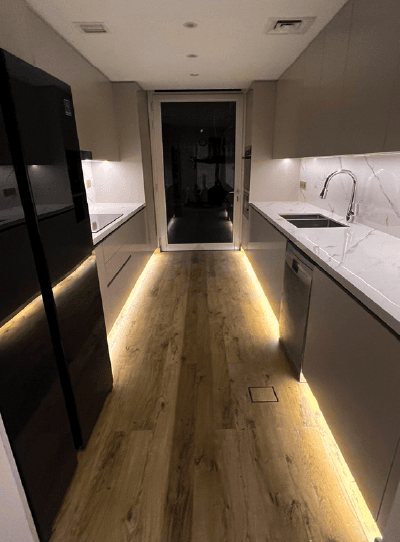
- KitchensSteam from the hob, oven heat and the splash at the sink work joinery harder than any other interior room, so start with a moisture-resistant carcass, laminate or lacquered fronts and a sealed edge on every panel, with foil kept away from the hob. Our custom kitchen cabinets page lists laminate, lacquer, veneer or framed doors, calls for boards and edges that resist water near the sink and dishwasher, and suggests comparing quotations line by line.
- Bathrooms and laundriesA vanity stands on a wet floor under a basin splashed every morning; a laundry cabinet sits beside a machine venting damp air. Use moisture-resistant MDF or wet-area plywood, a laminate or lacquered face, a thick edge on every panel, legs or a plinth off the floor and a ventilation gap behind the unit.
- Bedrooms and wardrobesThe kindest rooms: standard MDF with a lacquered or veneered face for the doors and a melamine carcass inside, except where a wardrobe backs onto an en-suite shower and the back and base should be moisture-resistant. A ventilation gap or louvred door stops clothes turning stale when the AC is off.
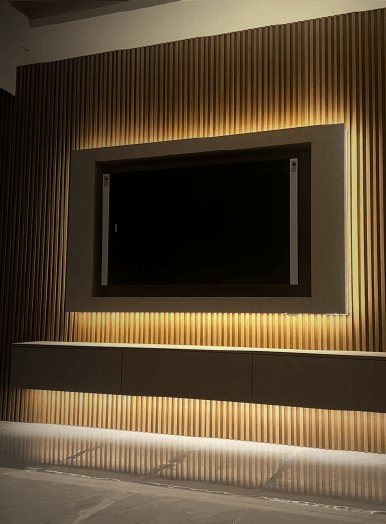
- Living room TV wallsA console that carries equipment, a backdrop seen across the room and cable routes behind both. Slats, veneer, lacquer or stone-effect panels are the usual faces, and a shelf under a heavy receiver wants plywood on a short span. Our custom TV wall units are planned with cables, panelling and lighting as one design.
- Interior doorsHollow, semi-solid and solid cores differ in weight and sound; the face can be veneer, lacquer or paint. A door between a cool bedroom and a warm corridor needs sealed edges that cope with the humidity difference across the leaf; our custom wooden doors page covers cores, finishes and frames.
- Outdoor joineryCabinet doors under a barbecue counter, a bench by the pool and a slatted boundary screen face sun that bleaches timber and foil, sand that scours gloss and salt air near the coast. Interior boards do not survive outside; choose oiled hardwood, exterior-grade plywood with exterior paint or a timber-look composite, with stainless hardware. Our outdoor cabinet doors, benches and slatted screens come from the same workshop as the indoor pieces; see our outdoor living page.
What to specify in a joinery quotation
Words that protect you when quotations look alike
Quotations for the same wardrobe differ widely because one describes a melamine carcass with paper edges and another a moisture-resistant board with a thick sealed edge, and neither says so. Ask for the board type and grade of carcass, shelves and fronts; the face on each and its sheen; the edge type and where it goes; the hinge and runner type and load rating; the interior fittings; and the finish inside the doors. Our guide to commissioning made-to-measure furniture explains how to read the drawings, which should show every elevation and sections through the carcass.
Ask also where the pieces are made and who fits them, because a board cut in a clean workshop behaves differently from one cut in your bedroom. Our joinery is made in the workshop and installed by our own carpenters, who fit it once the room is closed and the air-conditioning is running, with small allowances for movement in long runs of panelling and skirting. Ask for samples of the face and the edge, record the approved sample on the quotation, and check the developer's or community management's rules on access, working hours and any no-objection certificate before the delivery date is set.
Care and cleaning in the Dubai climate
Most joinery in Dubai is damaged by habits rather than by use. These habits keep boards flat and faces bright.
Keep the AC steady
Switching the air-conditioning off for the summer lets the humidity climb and every board take on moisture; when it returns the boards dry and shrink. Leave it running at a higher set point while you are away and keep wardrobe doors ajar.
Dust dry, wipe damp, never wet
Dubai dust is fine and abrasive, so dust lacquer and gloss with a soft dry cloth before wiping, or the grit scratches the surface. Wipe laminate and melamine with a damp cloth, dry it, and never let water stand on a joint or an edge.
Mind the sun
Veneer, foil and dark lacquer fade or yellow in direct sun through a large window. Blinds or a film on the glass protect the joinery as much as the fabric.
Adjust before it breaks
A door that catches or a drawer that drops needs a hinge adjustment or a runner reset, not a new door. Do it early, because a door that rubs wears its edge through to the core.
Joinery finishes from our projects
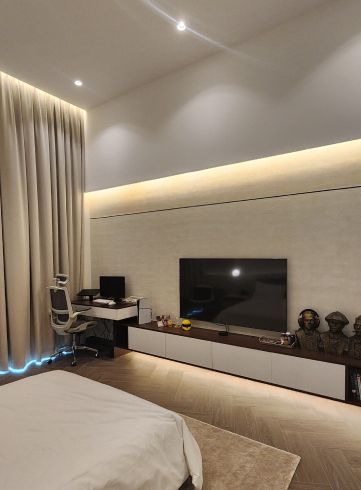
Project Beyond
Dubai Land, Dubai · Approx. 430 sqm · Q1 FY24 to Q2 FY24A long low white TV console with a dark top under a wall-mounted TV on a textured feature wall, with a cove-lit ceiling recess, in a bedroom of a corner-unit villa in Dubai Land whose scope included bespoke joinery across all bedrooms and custom wardrobes by our in-house team.
View project →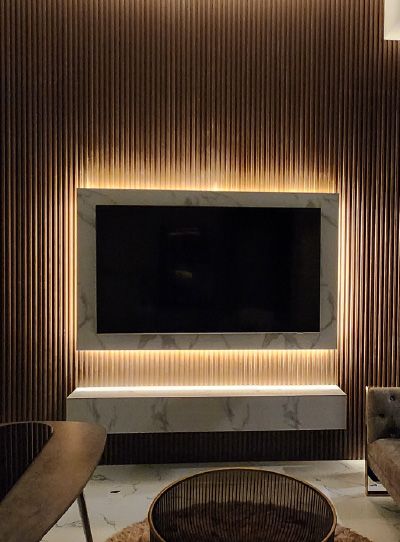
Project Murano
Al Furjan, Jebel Ali · 210 sqm · April 2024 - May 2024A wall-mounted TV in a white veined frame with warm backlighting on a brown vertical slatted wall and a floating unit below, from a refurbishment in Al Furjan that included flooring, joinery works and refurbished kitchen, doors and cupboards.
View project →More of our work: YouTube · Instagram · our Google reviews
Questions and answers
Which joinery material lasts longest in Dubai?
Is MDF or plywood better for wardrobes?
Does solid wood joinery work with air-conditioning?
What is the difference between laminate and veneer?
Can painted or lacquered joinery be repaired?
What should a joinery quotation list?
More guides
Our related services
Contact Us
Ready to bring
your vision to life?
Get in Touch
We appreciate your interest in OutMazed ® Design and would be delighted to assist you with your design requirements. Our team of professionals are committed to providing you with the highest standard of service and satisfaction possible.
Please feel free to contact us and let us know what you're interested in or looking for. We are here to assist you whether you need help with a new project, renovation, or just some design advice. Fill out the contact form below, and one of our staff will contact you as soon as possible.
Alternatively, you can also reach us via phone or email, and our friendly staff will be happy to help you. We encourage you to take the first step towards transforming your space with OutMazed ® Design by contacting us today.