Desert landscaping and xeriscaping for Dubai villas
A desert garden does not have to be bare. Desert landscaping and xeriscaping use plants, stone and shade that suit the climate, so a villa garden stays green where it matters and needs much less water. These ideas cover zoning, planting, gravel and paving, watering, lighting and upkeep.
Free site visit · Approvals handled by us · Designed in 3D
What desert landscaping and xeriscaping mean
Desert landscaping is garden design that works with a dry climate instead of fighting it: plants that cope with heat and little rain, natural materials such as gravel, stone and sand-coloured paving, and shade where people sit. Xeriscaping, from the Greek word for dry, is the method behind it: planning a garden to need as little extra water as possible once the plants are established. In a Dubai villa, that rarely means a bare plot of gravel. It usually means a smaller green area near the house, a planted and gravelled garden around it, and an efficient way to water what remains. Whether you want a full desert landscape or a lower-water version of a classic garden, our landscape design team plans the zones, planting and materials together and shows you the result in 3D before work starts. For wider layout ideas, see our garden design ideas for Dubai villas.
Oasis, transition and arid zones
The core idea of xeriscaping is to spend water where it gives the most back, so divide the garden into zones by water need.
An oasis zone by the house
Give the fullest planting, and a small lawn if you want one, to the part of the garden you use and see most: the terrace, the main seating and the view from the living room. The thirstiest plants then sit where they are easiest to water and check.
A transition zone
Between the house and the boundary, use plants that need moderate water and still look good with less: flowering shrubs, ornamental grasses and climbers on the walls. Gravel or pebbles between them keep the beds tidy and the soil cooler.
An arid zone at the edges
Along the boundary, the side passages and the far end, use the toughest plants: succulents, desert trees and groundcovers that need little water once established. Spaced out with stone and gravel, they give the garden its desert character.
A dry zone with no planting
Paths, seating areas and decorative gravel beds need no water at all. Stepping stones, a gravel court around a fire pit or a bed of boulders can take over ground that would otherwise be lawn to water and mow.
Lawn only where it is used
A natural lawn is the thirstiest part of most Dubai gardens. Keep it to the area where children play or people sit, or choose artificial grass for a green surface you never irrigate.
Plants that suit a desert garden
Native and drought-tolerant plants are the backbone of desert landscaping. Here they are grouped by the job they do in the design; the species themselves, and where each grows best, are covered in our guide to outdoor plants and trees for Dubai gardens.
- Date palms for height and outlinePalms give a desert garden its outline against the sky. Planted in a row along a boundary, or as a loose group at different heights, they frame the view on a small footprint. Their crowns throw only a small pool of shade, so pair them with a wider tree or a structure over the seating.
- Ghaf and other desert trees as the anchorNative desert trees cope with heat and drought once their roots are established. Give one tree with a broad crown the best spot, over a seating area or in front of a hot wall, and arrange the rest of the planting around it.
- Bougainvillea for colour on the wallsTrained on wires along a plain boundary wall or up a pergola post, bougainvillea brings strong colour to pale render and stone. Repeating one colour along a wall looks calmer than mixing several.
- Succulents as living sculptureAloes, agaves and cacti have strong, sculptural shapes that read best with space around them. Set them in gravel singly or in loose groups, so each outline stands out against the stone.
- Ornamental grasses for movementGrasses soften the hard lines of gravel and stone and move in the evening breeze. Planted in drifts rather than single clumps, they link the planting beds to the dry areas around them.
- Low groundcovers between stonesLow, spreading plants between stepping stones or along a gravel edge blur the line between planting and paving, so dry areas look finished rather than empty.
Gravel, pebbles, boulders and sand-tone paving
Ground that never needs watering
In a desert garden the ground itself is a design material. Gravel and crushed stone cover large areas with no water, and their colour sets the mood: pale stone for a bright, modern look, warm sand tones that echo the desert, darker stone for contrast. Very white stone can glare in full afternoon sun, so warm tones often suit large open areas better. White or river pebbles suit planting beds and lawn edges, and a few large boulders, partly buried rather than set on top, give a gravel bed a focal point. Decomposed granite, a fine crushed stone that packs into a firm surface, makes a soft-looking path that still drains. A weed membrane underneath and a firm edge keep gravel clean and in place.
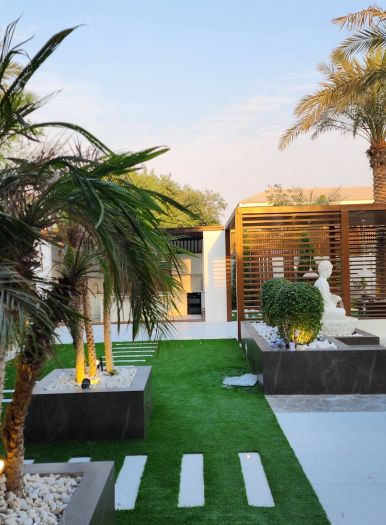
Sand-tone paving and large slabs sit naturally beside gravel and carry the routes used every day. For lighter routes, stepping stones keep the gravel or planting running between each step. Project Celine in Mudon pairs a stepping-stone pathway with natural landscaping and greenery, and in Project Casa Colonia in The Villa, palms stand in planters topped with white pebbles beside stepping slabs across the grass. We plan paving and stepping stones together with the planting in 3D, and our own team lays them with the rest of the garden landscaping.
Shade, soil, mulch and water
Desert plants still need a good start, and the people using the garden need shade.
Shade from trees and structures
Shade cools the ground, cuts the water plants lose through their leaves and makes the garden usable. Young trees take a long time to cast real shade, so a pergola, a gazebo or a shade sail over the seating, set against the afternoon sun, gives cover from the first day. The gazebo in Project Majestic in Al Twar offers a shaded seat in the garden, reached by stepping slabs set in white pebbles.
Better soil only where roots grow
Improve the soil where it pays, not across the whole plot. Planting pits and beds filled with improved, free-draining soil with some organic matter hold water around the roots for longer without waterlogging them, while gravel and paved areas can stay on firm, compacted ground.
Stone or organic mulch
Gravel, pebbles or organic mulch over the soil shades it, slows evaporation and holds back weeds. Pale stone suits the desert look and does not break down or blow away, though dark stone stores heat; organic mulch feeds the soil but needs topping up.
Drip irrigation on a timer
Even desert plants need regular water while they establish. Drip lines put it at the roots, and a timer waters each zone separately. How a system is put together is explained in our guide to drip irrigation, and the irrigation systems we install are laid out to follow the planting plan.
Fewer, larger beds
A few generous planting beds are easier to water, mulch and look after than many scattered borders and pots, and they read more clearly against gravel and paving.
Lighting a desert garden after dark
Stone, palms and sculptural plants make strong shapes at night, and a desert garden needs only a few lights to show them. Ideas for paths, walls and seating are in our garden lighting ideas.
Cast shadows from sculptural plants
A small spike light set low in front of an agave, a group of aloes or a cactus throws its outline onto a pale wall behind, so one plant gives two shapes after dark.
Light a row of palms the same way
Where palms stand in a row, give each one the same fitting, angle and colour of light, so the row reads as one line along the boundary at night instead of a scatter of bright trunks.
Skim light across boulders and gravel
A low light set close to a boulder, or aimed across a gravel bed, picks out the texture of the stone. Warm light keeps sand-coloured stone from looking grey.
Leave some of the garden dark
Light the features and the routes, not every bed. Dark stretches of gravel between lit plants keep the calm of a desert garden at night, and fewer lights mean fewer cables to run under the stone.
Palms, pebbles and stepping stones in our projects
Project Miracle
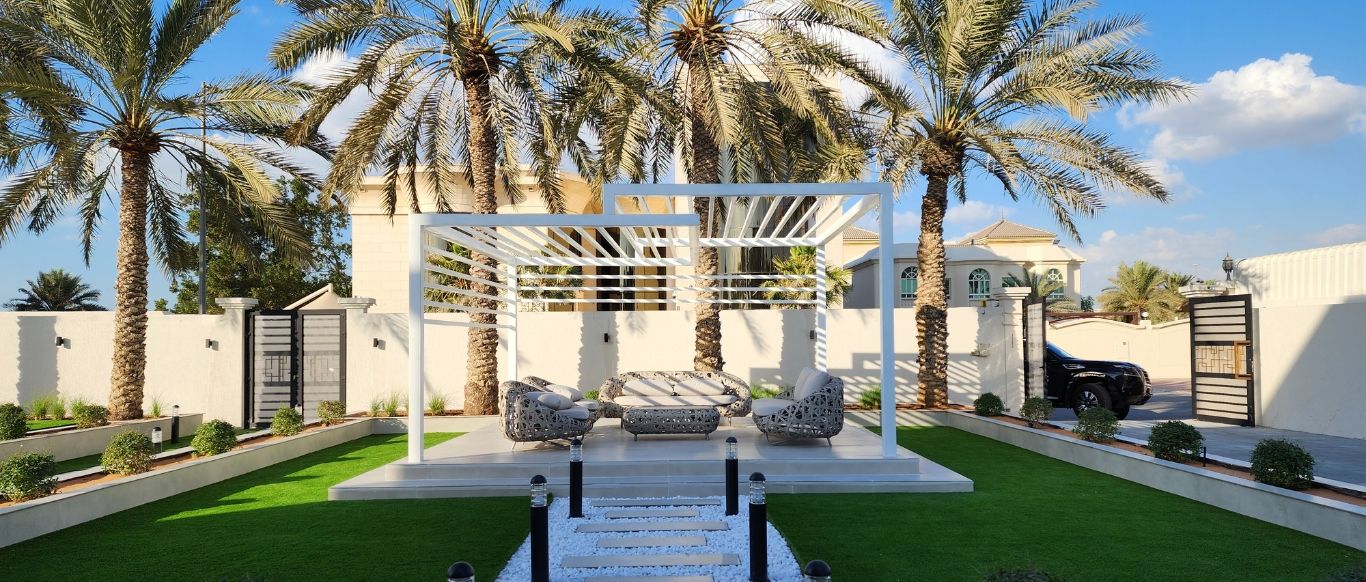
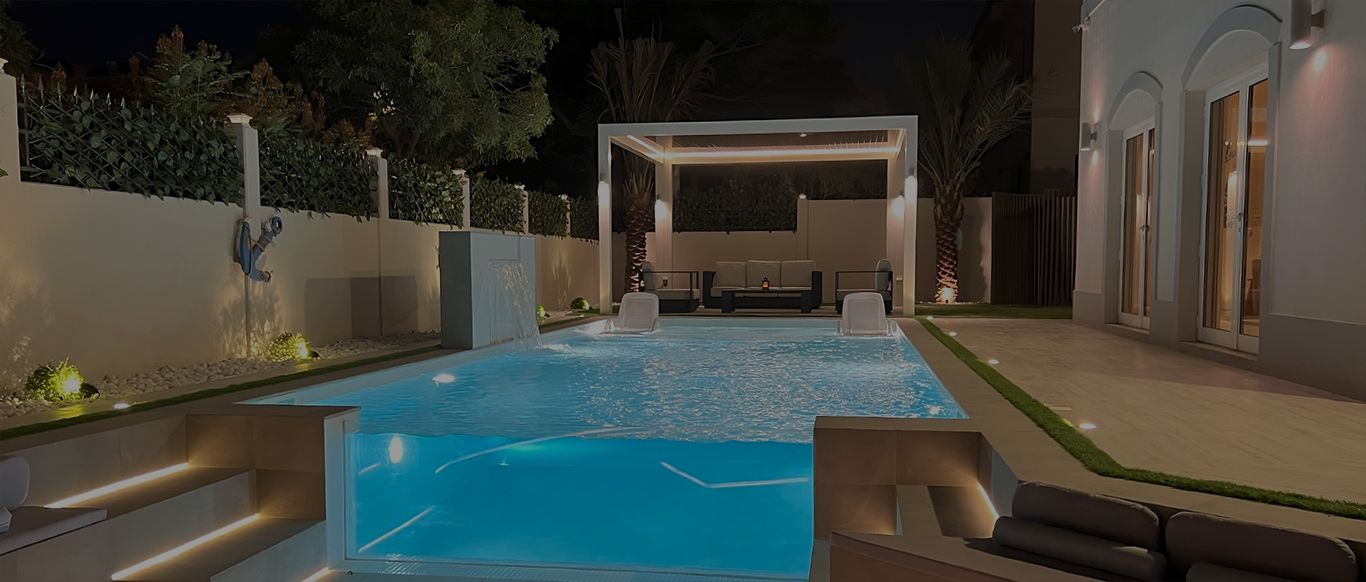
The Villa, Dubai · 1500 sqm · December 2022 - May 2023Date palms frame the outdoor seating that the glass-corner pool overlooks. The project in The Villa was a complete makeover inside and out, with a gazebo, a pergola and a redesigned boundary wall.
View project →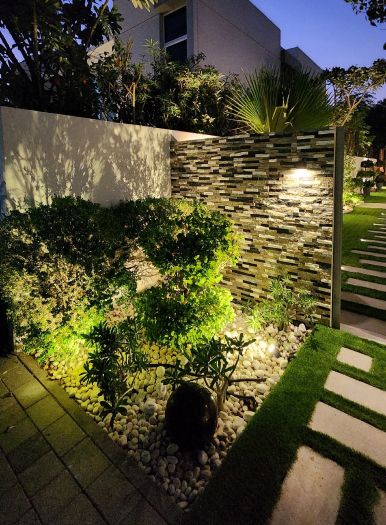
Project Violet
Dubai, UAE · Approx. 520 sqm · Q2 FY24 to Q3 FY24Shrubs in a bed mulched with pale pebbles in front of a lit feature wall, from an outdoor recreational area that was fully reimagined in a complete villa redesign.
View project →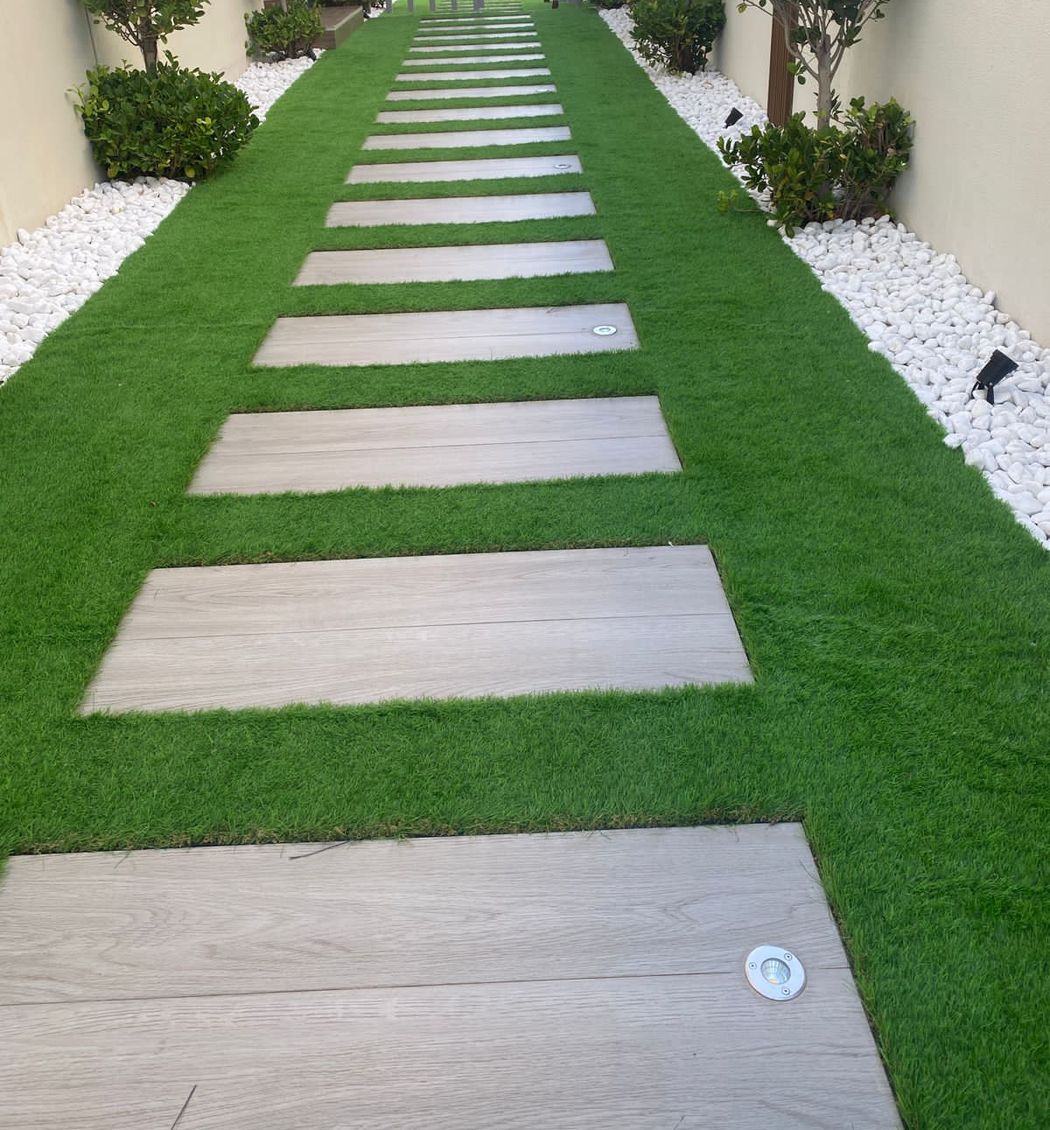
Project Alpha
Damac Hills 2, Dubai · 200 sqm · November 2022 - December 2022Stepping stones through artificial grass, with white pebble borders and shrubs along the walls. Landscaping and ambient lighting were part of the same contemporary outdoor space in Damac Hills 2.
View project →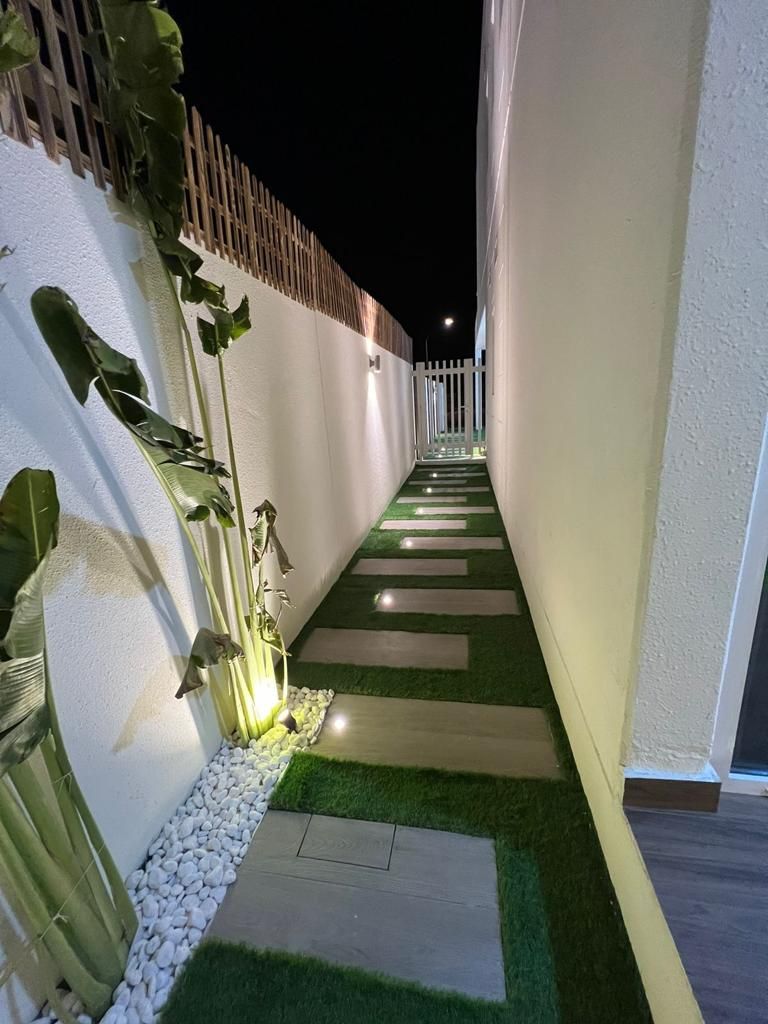
Project Bold
Damac Hills 2, Dubai · 250 sqm · August 2022 - September 2022A side passage at night, with lit stepping stones in artificial grass, white pebbles and a plant picked out by a spike light, in a Damac Hills 2 project with well-planned outside lighting.
View project →More of our work: YouTube · Instagram · our Google reviews
Looking after a desert garden
A xeriscape is a low-maintenance garden rather than a no-maintenance one: it needs far less work than a garden of lawn and hedges, but it is not maintenance-free. If you would rather not do it yourself, our garden maintenance team can take it on.
- Step the watering downAs plants establish, shorten the run times zone by zone instead of keeping the schedule set at planting, and check the drippers and filters while you do.
- Keep the gravel cleanClear leaves and wind-blown sand before they form a layer weeds can root in, and rake and top up the gravel where it has thinned.
- Pull weeds while they are smallWeeds coming through gravel are easiest to remove before they set seed, and a sound membrane keeps them few.
- Prune with a light handDesert plants usually look best in their natural shape. Remove dead palm fronds and spent flower stems, and cut back bougainvillea after a flush of flowers to keep it clear of paths and windows.
- Watch new plants through their first summerScorched or wilting leaves on a new plant are an early sign that it needs more water or shade. Acting early often saves a plant that would otherwise need replacing.
Questions and answers
What is the difference between desert landscaping and xeriscaping?
Will a xeriscape garden look bare?
Does a desert garden still need irrigation in Dubai?
Is artificial grass part of xeriscaping?
Can an existing lawn garden be turned into a desert garden?
Does gravel make a garden hotter?
Can you design and build a desert landscape for our villa?
More guides
Our related services
Contact Us
Ready to bring
your vision to life?
Get in Touch
We appreciate your interest in OutMazed ® Design and would be delighted to assist you with your design requirements. Our team of professionals are committed to providing you with the highest standard of service and satisfaction possible.
Please feel free to contact us and let us know what you're interested in or looking for. We are here to assist you whether you need help with a new project, renovation, or just some design advice. Fill out the contact form below, and one of our staff will contact you as soon as possible.
Alternatively, you can also reach us via phone or email, and our friendly staff will be happy to help you. We encourage you to take the first step towards transforming your space with OutMazed ® Design by contacting us today.