Artificial grass in Dubai: types, quality and what drives the price
Artificial grass looks the same in a photo and very different on the ground. This guide explains the types, what separates a good product from a poor one, and the factors that drive the price of an installed lawn in Dubai, so you can compare offers properly.
Free site visit · Approvals handled by us · Designed in 3D
Why there is no single price for artificial grass
Owners usually ask for a price per square metre first. It is a fair question, but the figure on its own tells you very little. Quotes for the same area can describe very different things: a short, thin grass dropped onto the existing ground, or a dense, heavy product laid on a compacted base with proper drainage and edges. The grass is only part of an installed lawn. Under it sit the base, membrane and drainage, in it the infill, and around it the edges, paving and planting that have to be made good. That is why we do not publish prices for artificial grass installation: we lay it as part of a garden, not as a product sold by the roll, and the right answer depends on the site. What we can do is explain what moves the cost, so that when you compare quotes you can see whether they cover the same work. If you are planning the whole garden rather than a single lawn, our garden design ideas for Dubai villas cover the layout around it, and our landscaping team designs the grass with the paving, planting, irrigation and lighting, shows you the garden in 3D, and installs it as one project.
Types of artificial grass
Artificial grass is made for different jobs, and the type you need is the first thing that sets the price.
Landscape grass for lawns
The type a family garden usually needs: a medium to long pile with a mix of green tones and a brown or beige thatch that imitates a natural lawn. Softness, realism and how well the pile stands up after being walked on are what you pay for.
Short-pile grass for edges, terraces and balconies
A shorter, denser pile suits narrow strips between paving, roof terraces and balconies, where a long pile would be hard to brush and would catch on doors and furniture.
Play grass for children
Grass made for play areas is softer underfoot, often with a padded shock layer beneath it, and has to cope with concentrated wear under swings and slides.
Pet grass
A grass for dogs has a backing and an infill chosen for drainage and odour control, with a resilient yarn that recovers from digging paws and regular rinsing.
Putting green turf
A putting green uses a very short, dense turf, usually sand-filled, that rolls true, laid on a precisely shaped and compacted base. The base work, not the turf, is where much of the cost sits.
What drives the price: the grass itself
When you hold samples side by side, these are the differences you are paying for.
Pile height
The length of the fibres above the backing. A longer pile looks fuller and softer and uses more yarn, but it flattens more easily under furniture and traffic and takes more brushing. A shorter pile stands up better, feels firmer and suits busy routes and small spaces.
Density and stitch rate
How much yarn is packed into each area of backing, set by the stitch rate along the row and the gauge between rows. A dense grass hides the backing, resists flattening and weighs noticeably more in the hand. A sparse grass can share the pile height yet show its backing the moment it is parted.
Yarn shape
Fibres are extruded in different cross-sections: flat, C-shaped, diamond or W-shaped. Shaped fibres have a spine that helps them spring back and they scatter light so the lawn shines less. Flat fibres are cheaper, shinier and flatten sooner.
Yarn material
Landscape grass usually uses polyethylene for the long green fibres, because it is soft and holds its colour, with polypropylene for the curled thatch. Nylon is tougher and springier but harsher to the touch and more expensive, so it appears in putting greens and heavy-wear turf.
Thatch and colour mix
A realistic grass mixes several green tones with a brown or beige thatch curled at the base. Single-tone, bright green grass with no thatch is cheap to make and easy to spot from across the garden.
Backing
The fibres are tufted into a primary backing, then locked in with a coating. Latex is the standard; a polyurethane coating holds the tufts more strongly, does not absorb water and copes better with heat and pets. A double primary backing helps stop the roll stretching and the seams opening.
UV stabilisation
Fibres treated against ultraviolet light keep their colour and flexibility far longer in the Dubai sun. The treatment is invisible in a sample, so it has to come from the data sheet.
What drives the price: the ground under the grass
The part of the quote you never see
A good product on a poor base fails quickly: it ripples, puddles, sinks at the edges and shows every footprint. The base is where quotes differ widely, and where low offers usually cut. Removing a natural lawn, old paving or compacted sand comes first, including disposal. Then the ground is shaped to fall gently towards a drain or a planted bed, a compacted layer of crushed aggregate is laid and topped with a finer blinding layer, and a weed membrane goes down. In a narrow side passage with no access for a machine, all of this is done by hand and carried through the house, which costs more.
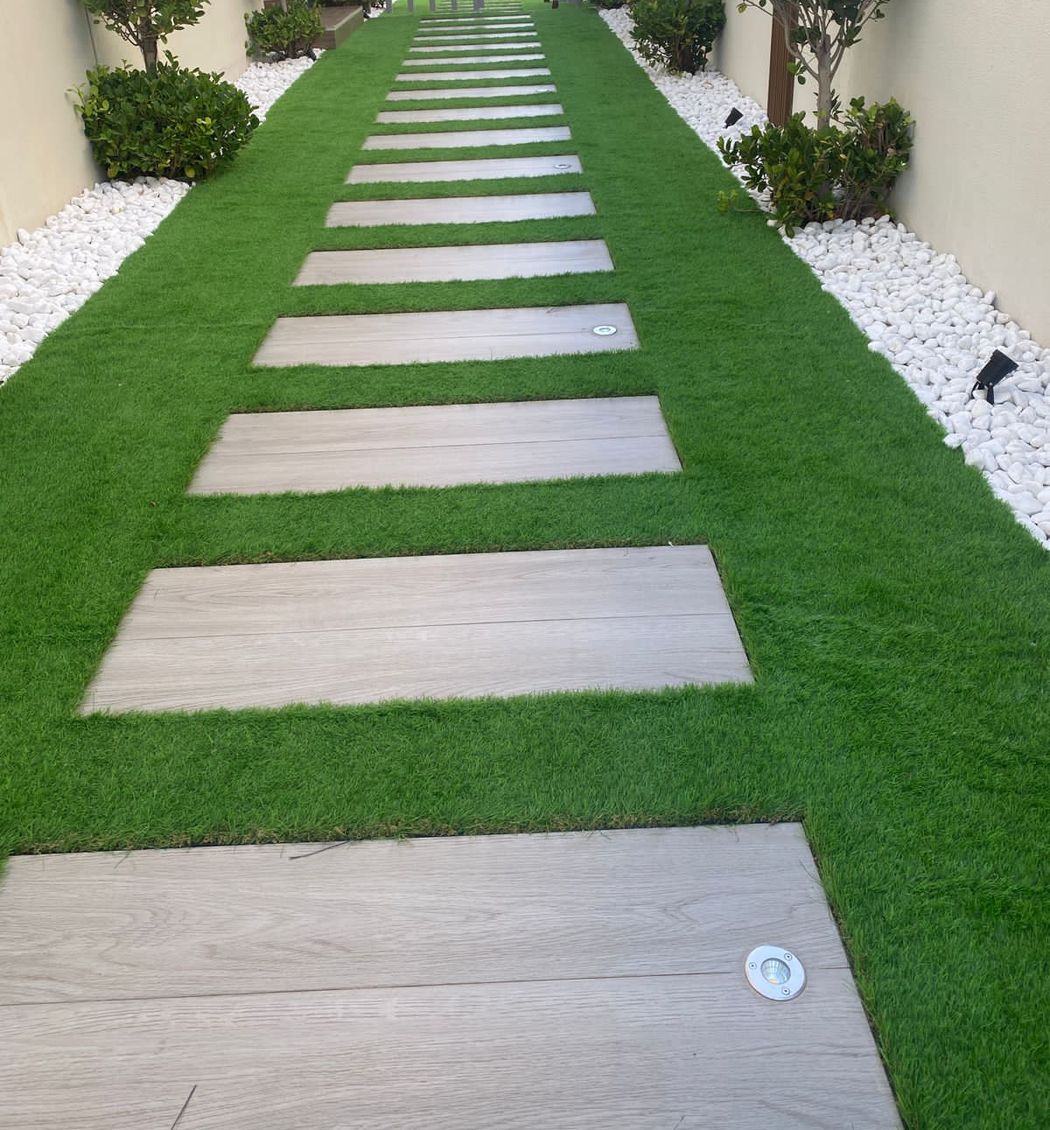
The grass is then laid with the pile facing the same direction on every roll, joined with seaming tape and adhesive, fixed around the perimeter, and finished with an infill, usually kiln-dried sand, brushed between the fibres. The infill keeps the pile upright, holds the grass down and protects the backing from the sun. Edges matter as much as the base: a firm edge of paving, or a concealed timber or metal edging, stops the grass lifting. Stepping stones set into the grass, as in Project Alpha in Damac Hills 2, need each stone bedded and the grass cut neatly around it, so a path through the lawn adds work compared with an open rectangle. Waste adds cost too: an L-shaped garden with many cuts uses more roll than a square of the same area.
Dubai conditions that change the choice
Artificial grass behaves differently in a Dubai summer from the climate many data sheets are written for. These local factors change the product, the base and the price.
- Heat underfootArtificial grass in full sun gets hotter than a natural lawn, enough to be uncomfortable for bare feet and paws in the afternoon. Lighter and mixed green tones, a pale infill and a quick rinse before use all bring the surface temperature down, and shade over the part of the lawn you use makes a greater difference than any product choice. In a water-wise garden, artificial grass often sits near the house: it needs no irrigation, but it does need shade to be usable in summer.
- Sand and dustWind-blown sand settles into the pile and, left alone, packs into a hard layer that stops drainage and flattens the fibres. A pile kept topped up with infill leaves less room for it to settle, and a regular brush and rinse keeps it moving.
- Rain and drainageRain is rare but can be heavy, and a lawn with no fall and a membrane that does not drain becomes a pond. The base has to be shaped to a drain or a soakaway, and the backing fully perforated.
- PetsDogs need a grass with a fully permeable backing, an infill that does not hold odour, and a resilient yarn. Hosing the lawn through regularly is part of keeping a dog on it.
- ChildrenUnder swings, slides and climbing frames, impact matters more than looks. A padded shock layer under the grass, or a dedicated EPDM or rubber play surface where the equipment stands, cushions a fall far better than grass on a hard base.
- Watering the garden around itArtificial grass needs no water, but the beds, hedges and pots beside it do, and sprinklers that throw water over the grass leave salt and mineral marks on the fibres. Drip lines to the planting, laid before the grass goes down, keep the irrigation where it belongs and the lawn dry.
What decides the lifespan of artificial grass
Lifespan is not a fixed figure on a label. These are the factors that move it.
UV resistance
The Dubai sun is the main thing that ages artificial grass. A fibre with good UV stabilisation fades slowly and stays flexible; a cheap fibre turns pale and brittle and breaks at the tips long before a good one shows wear.
Yarn resilience
Shaped, thicker fibres with a spine recover after being pressed; thin, flat fibres lie down and stay down. Resilience shows first on the routes people walk daily.
Backing and seams
Tufts pulling out and seams opening are the usual failures of a poor product. A strong coating and a stable double backing hold the grass together, and a well-made seam should not be the weak point.
Traffic, furniture and infill
A lawn used daily by children and a dog ages faster than one looked at from the terrace. Furniture left in one spot flattens the pile; moving it now and then and brushing the area lets the fibres recover. Infill that is never topped up leaves the backing exposed to the sun.
Installation quality
A compacted, well-drained base, firm edges, a consistent pile direction and tidy seams make the same product last far longer. Early failures are usually installation failures rather than product failures.
Artificial grass in our projects
Project Alpha
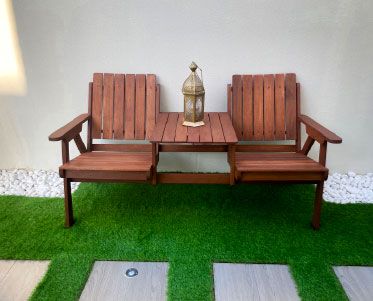
Damac Hills 2, Dubai · 200 sqm · November 2022 - December 2022A wood-tone garden bench with a lantern on artificial grass, with large rectangular stepping stones, an in-ground light and a white pebble border against the wall. Project Alpha in Damac Hills 2 paired fake grass with wall cladding, stepping stones and ambient lighting in a contemporary outdoor space.
View project →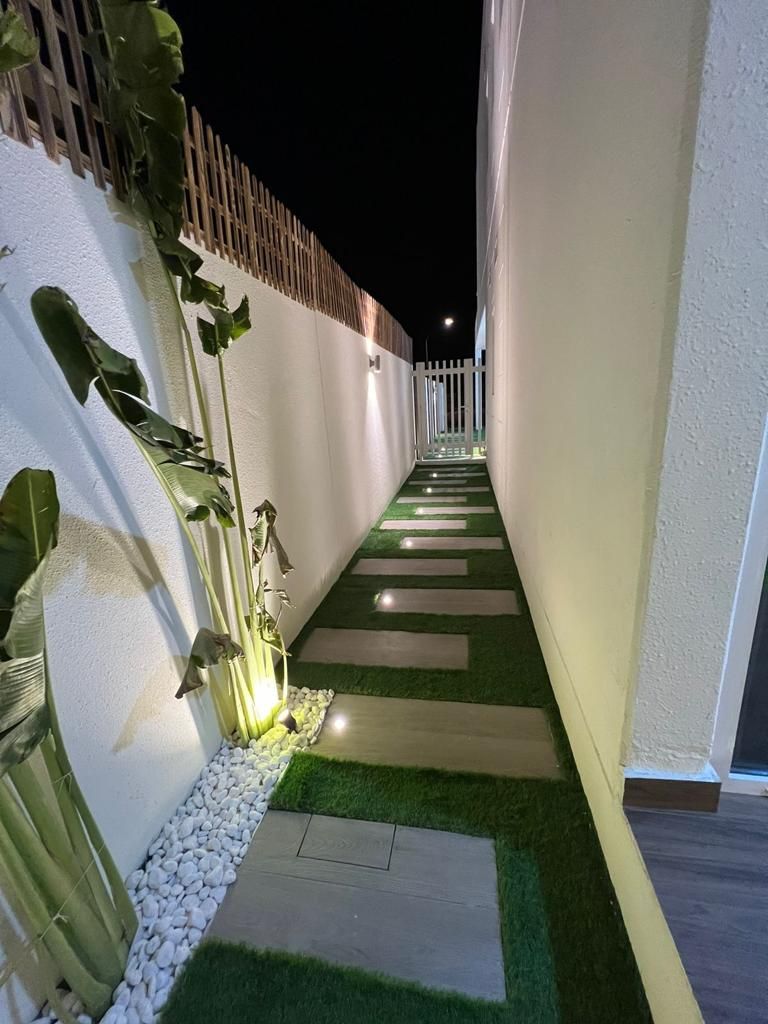
Project Bold
Damac Hills 2, Dubai · 250 sqm · August 2022 - September 2022A narrow side passage at night, with stepping stones set in artificial grass, some lit from below, white pebbles and large-leaved plants picked out by a spike light. Project Bold in Damac Hills 2 combined artificial grass with plant spike lights, stepping stones and well-planned outside lighting.
View project →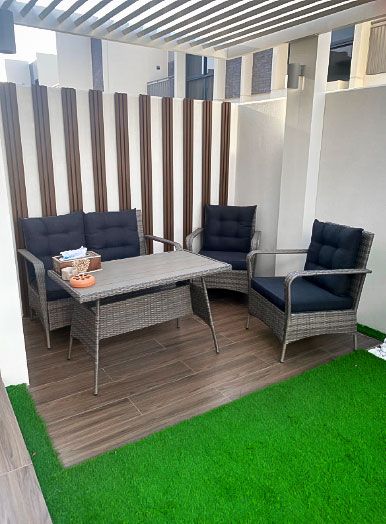
Project Alpha
Damac Hills 2, Dubai · 200 sqm · November 2022 - December 2022An outdoor seating corner on a wood-look deck edged by artificial grass, with vertical slat panels on the wall and a white slatted shade structure overhead, also in Project Alpha.
View project →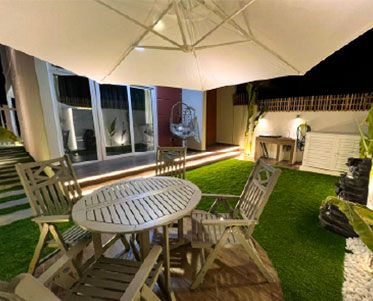
Project Bold
Damac Hills 2, Dubai · 250 sqm · August 2022 - September 2022Outdoor seating under a large parasol on a wood-look deck set into artificial grass, beside a raised platform with lit edges, a hanging egg chair and white pebbles, in Project Bold.
View project →More of our work: YouTube · Instagram · our Google reviews
How to judge a sample
Ask for a sample of every grass you are quoted and compare them side by side in daylight, not under showroom lights.
Weigh it in your hand
Of samples the same size, the heavier one has more yarn or a heavier backing. Weight is a quick guide to density.
Part the pile
Push the fibres apart with your fingers. If you see backing straight away, the grass is sparse and will show its base when walked on.
Press, rub and release
Rub the sample back and forth to mimic foot traffic, press it flat with your palm and watch it. Shaped fibres spring back; flat fibres stay down.
Pull a tuft and turn it over
Pinch some fibres and pull; they should not come out. On the back, look for a dense, even coating, a second backing layer and plenty of drainage holes, then pour water on the face and watch how fast it runs through.
Check the shine and the colour
Hold it in the sun at an angle. Heavy shine usually means flat, cheap fibres. Look for several green tones and a brown thatch, and compare the colour with the planting it will sit beside.
Read the data sheet and the quote
Pile height, stitch rate, yarn weight, backing type and UV treatment should all be written down; if the quote names only 'premium grass', ask which product it is. Then check the scope: removal and disposal, base depth and material, membrane, drainage, seaming, edging, infill and making good around the lawn. A lower price often means one of these is missing.
Questions and answers
How much does artificial grass cost in Dubai?
What is the difference between cheap and expensive artificial grass?
How do you keep artificial grass cool enough to use in a Dubai summer?
Is artificial grass suitable for dogs?
How long does artificial grass last?
Can artificial grass be laid over an existing lawn or paving?
Do you supply artificial grass on its own?
More guides
Our related services
Contact Us
Ready to bring
your vision to life?
Get in Touch
We appreciate your interest in OutMazed ® Design and would be delighted to assist you with your design requirements. Our team of professionals are committed to providing you with the highest standard of service and satisfaction possible.
Please feel free to contact us and let us know what you're interested in or looking for. We are here to assist you whether you need help with a new project, renovation, or just some design advice. Fill out the contact form below, and one of our staff will contact you as soon as possible.
Alternatively, you can also reach us via phone or email, and our friendly staff will be happy to help you. We encourage you to take the first step towards transforming your space with OutMazed ® Design by contacting us today.