Native and water-wise plants for Dubai gardens
A villa garden in Dubai is planted into sand, watered by pipe and lived in through a long summer, so the plants you choose decide how much water, work and replacement the garden needs for years. This guide is for an owner choosing a planting palette: what native and climate-adapted plants are, how to build the palette in layers, where trees, palms, hedges and pots belong, and how the choice feeds the irrigation, the upkeep and the garden design.
Free site visit · Approvals handled by us · Designed in 3D
Why the planting has to suit Dubai before it suits your taste
Every plant in a Dubai garden is working against the site. The soil on most villa plots is sand with little in it to hold water or feed roots, and near the coast it can be salty as well. Summer brings months of heat, strong sun and dry wind, then weeks of humidity that stress plants in a different way, and there is almost no rain, so whatever grows is kept alive by irrigation. A plant that is not built for those conditions survives on water, shade cloth and constant attention, and it is usually the first thing replaced after its first summer. A plant that is built for them needs a fraction of the water and the work and still looks right in the heat. That is why the planting palette is one of the first decisions in a garden design drawn in 3D, before paving, lighting or structures are placed: the plants set the water zones, the shade, the privacy and the maintenance the garden will need. Our list of plants and trees for Dubai covers individual species; this guide is about how to choose between them and build a palette that holds together.
Native, adapted or thirsty: which plant is which
Most Dubai gardens mix all of them. The point is to know which is which, keep the thirsty group small and put it where it earns its water.
Native plants
Species that grow wild in the Emirates or the wider Gulf: the ghaf and the sidr among trees, the date palm, and the desert grasses and small shrubs that cover dunes and wadis. They generally cope with heat, drought, poor sand and in some cases salt, and once their roots are down they need little irrigation. Their look is soft and silvery rather than lush, so they suit a garden that wants to feel of its place, and they are the backbone of the schemes in our guide to desert landscaping and xeriscaping.
Climate-adapted plants
Plants from other hot, dry parts of the world that have proved themselves in Dubai: bougainvillea and oleander for colour and screening (take advice on oleander where children or pets use the garden), plumeria and hibiscus for flowers, jasmine for scent, agave, aloe and other succulents for shape, ornamental grasses for movement, and olive and citrus trees where fruit and a Mediterranean look are wanted. They need more care than natives, especially regular water in their first summers, but far less than tropical planting, and they give the colour and density most villa owners expect.
Thirsty exotics
Tropical and temperate plants chosen for a look: broad-leaved foliage, soft lawns, bedding flowers and anything that wilts by midday in July. They can be grown here, but only with heavy watering, shade and replacement, and they fail first on the hot western side of the garden. Keep them to a few pots or a sheltered bed close to the house, watered on their own line, rather than spreading them through the plot.
Building the palette in layers
Canopy, screen, middle, ground and accent
A palette is easier to choose as layers than as a list of favourites. The canopy comes first: the trees and palms that cast shade and give height, placed where the shade falls on seating and the glass doors in the afternoon. The screening layer runs along the boundary walls, dense shrubs or a hedge that give privacy from overlooking windows and take the dust off the wind. The middle layer fills the beds between the two with shrubs of medium height and the flowering plants that carry colour through the year. Ground cover closes the soil surface so the sand is not bare and watering is not lost to evaporation, and the accent layer is the handful of sculptural plants, a clipped shrub, an agave, a specimen tree in a pot, that give the eye somewhere to rest.
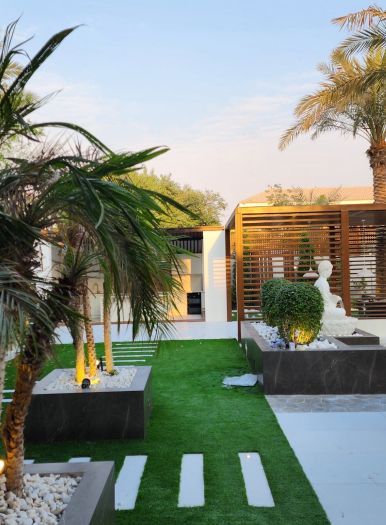
Keeping the number of species small makes a garden read as designed rather than collected: a few species in each layer, repeated along the garden, with the thirsty exotics confined to the accent layer close to the house. Each layer also has a water need, so grouping plants by layer tends to group them by thirst, which is what the irrigation zones are built on. At Project Casa Colonia in The Villa a few elements carry the garden: palms in dark planters with white pebbles and uplights, a lawn crossed by white stepping slabs, and a round shrub set against a slatted pergola screen. How the rooms of a garden are arranged around the planting is covered on our outdoor living page.
Shade trees and palms: where they go
Trees take years to replace, so their position matters more than that of any other plant. Decide it with the garden plan, not after the paving is down.
Shade where it is needed
Plant trees on the south and west sides of seating, play areas and the glass doors, so the canopy shades those spots in the afternoon; a tree on the east side only shades the garden in the morning. The ghaf tends to give light, filtered shade that still lets planting grow under it; the sidr gives a denser canopy but carries thorns, so it belongs away from paths.
Roots, walls and pipes
Fast-growing trees with spreading roots can lift paving, open joints in a boundary wall and find their way into drainage and pool pipework. Keep large trees well back from walls, the pool shell and any run of pipe, and favour palms and deep-rooted natives near structures. How paving and paths are built to stay flat is on our interlock and paving page.
Litter and the pool
Every tree drops something: leaves, flowers, fruit, old fronds or thorns. Beside a pool that litter ends up in the water and the skimmer, so choose tidy, slow species poolside, keep flowering and fruiting trees to the far side of the garden, and allow for palms to be cleared of old fronds as part of upkeep.
Palms for height, not shade
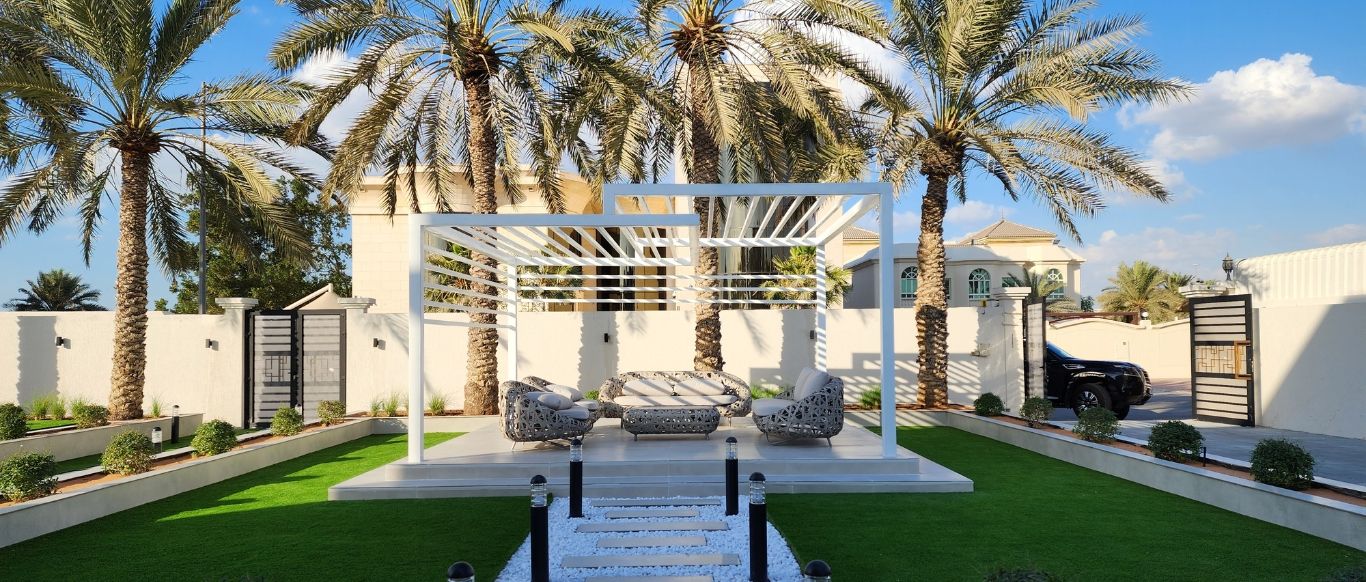
Date palms and their relatives give the silhouette Dubai gardens are known for and usually stand close to walls and pools without difficulty, but their shade is a narrow stripe. Use them for height along boundaries and around the pool, and plant a broad canopy tree where real shade is wanted. Palms also take uplighting well, which is why they so often carry the garden after dark; our landscape lighting page shows how planting is lit.
Hedges, lawn alternatives, pots and the edge of the pool
The rest of the palette is decided by what the garden has to do: screen the neighbours, give the children somewhere to run, green a terrace, and stay clean around the water.
- A hedge for privacy and dustA dense evergreen hedge along the boundary earns its place in a townhouse or villa garden: it hides the neighbour's upper windows, softens the rendered wall and catches wind-blown sand before it reaches the terrace. Choose a species that takes clipping and drought, give it its own drip line, and leave room to walk behind it for trimming. Where the wall itself is the feature, planting is kept low in front of it; our boundary wall design page shows the options.
- Lawn alternativesA natural lawn needs more water than any other part of a Dubai garden and is the first to brown in shade and summer. Keep it small and in the sun, or replace it with ground-cover planting, gravel and stepping stones, or artificial grass in the garden in shaded corners, around the pool and where children play. Artificial grass gets hot in direct afternoon sun, so it needs the shade of a tree or a pergola to stay usable, and the beds around it still need their irrigation.
- Pots and planters on terracesOn a roof terrace, a balcony or a paved courtyard the palette moves into containers. Pots dry out far faster than beds in the heat, so they suit succulents, agave, aloe, clipped shrubs, bougainvillea standards and small trees such as olive or plumeria, each on a planter line rather than hand watering. Large pots in a light colour tend to keep roots cooler than small dark ones, and every pot needs drainage and a saucer or gravel bed so water does not stain the paving.
- Shade for the plants as well as the peopleA pergola or a shade sail does for a bed what a canopy tree does: it takes the edge off the afternoon sun so that adapted plants, and the few thirsty ones, hold their leaves through summer. Plant the climbers that will cover it, bougainvillea or jasmine, at the posts; our custom pergolas page covers the frames.
- What to avoid near pools and pavingKeep thorny plants, heavy leaf- and flower-droppers, fruit trees and anything with invasive roots away from the pool and the paved surround. Avoid sprinkler-fed planting beside the deck, because overspray stains stone and feeds algae; use drip instead. Choose plants that tolerate the occasional splash of treated pool water, and leave a clean band of paving or pebbles between the water and the first bed so that soil and mulch do not wash in.
Water, season and upkeep by plant group
The palette decides the irrigation and the maintenance
Once the palette is grouped by layer and thirst, the watering follows it. Beds, hedges and planters are fed by drip lines that put water at the roots with little lost to the wind; trees and palms get bubblers that soak the root zone deeply; a natural lawn, if there is one, is the only part that needs sprays or rotors; and pots on the terrace run on their own small-bore lines. An automatic controller runs each zone on its own schedule, so the succulents are not watered like the lawn and the citrus is not watered like the ghaf. We plan the garden irrigation with the landscape design, so the zones come from the planting plan and the pipework is in before the paving goes down.
Timing matters as much as the plant. In Dubai the cooler months are the planting season: trees, hedges and beds put in then have time to root before their first summer and need far less nursing. Through the hot months the aim is to keep everything alive with adjusted watering, mulch over the beds and shade for the plants that struggle, and after summer the garden is reviewed for what struggled and should be swapped for something tougher. Upkeep differs by group: natives want little more than an annual tidy; hedges and climbers need clipping before and after summer; palms need old fronds cleared; flowering shrubs need feeding and deadheading; succulents mostly need to be left alone and never overwatered. Our garden maintenance service covers lawns, hedges, palms, beds and the irrigation itself, and our garden maintenance calendar sets out the year season by season.
How the planting plan is prepared with the garden design
A planting palette is not chosen from a nursery trolley; it is drawn. In our process the first site visit records sun and shade through the day, levels and drainage, privacy and views, and the water and power already on the plot. The garden is then designed around how you will use it, with the trees, hedges, beds, lawn or artificial grass and the irrigation zones placed together, and the whole scheme is shown in 3D so you can see how tall the hedge will stand against the wall, where the shade falls at the hour you sit outside and how the pots sit on the terrace. A planting plan then lists each plant by species, size and position, so the stock supplied and planted on site matches the drawing. Our own team builds the garden, and where the developer or community management requires a no-objection certificate for the works, we make the application. The wider scope, from paving and walls to planting and lighting, is described on our landscaping services page.
Planted gardens from our projects
Project Violet
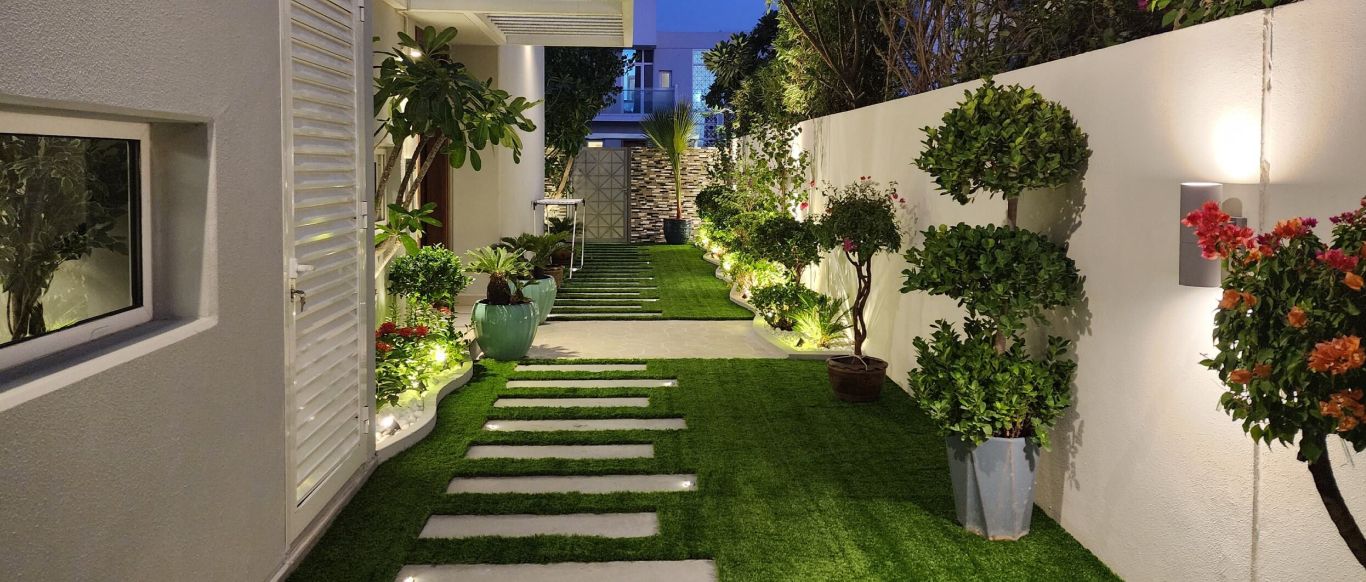
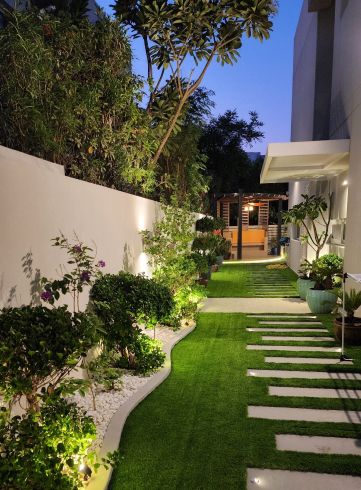
Dubai, UAE · Approx. 520 sqm · Q2 FY24 to Q3 FY24A narrow side garden at dusk with curved planting beds edged in white pebbles, shrubs including bougainvillea, potted plants and a frangipani-like tree along the villa wall, and stepping stones in turf that lead to a pergola-covered seating area. The fully reimagined outdoor recreational area was part of a complete villa redesign in Dubai that also included bespoke joinery and smart home automation.
View project →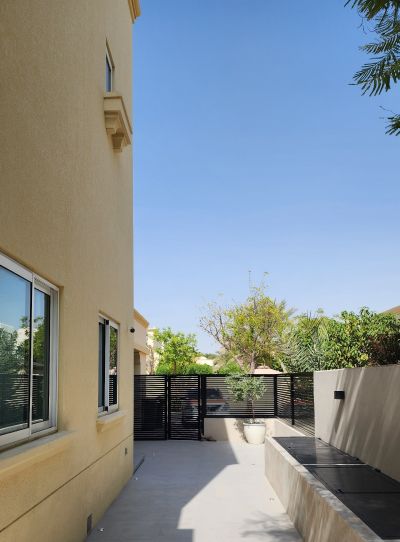
Project Barn
The Springs, Dubai · Approx. 420 sqm · Q4 FY25 to Q1 FY26A narrow paved side passage along the villa facade in The Springs, with a potted tree in a white pot standing by a black slatted fence and gate. The dedicated outdoor transformation followed a minimalist design language with weather-resistant materials, integrated lighting and custom detailing, executed by our in-house team.
View project →More of our work: YouTube · Instagram · our Google reviews
Questions and answers
What is the difference between a native and a climate-adapted plant?
Can a water-wise garden still look green and full?
How many different plants does a villa garden need?
Which trees suit a spot near a pool or a boundary wall?
What should I plant in pots on a roof terrace in Dubai?
When is the right time to plant a new palette?
Do you prepare the planting plan as part of the garden design?
More guides
Our related services
Contact Us
Ready to bring
your vision to life?
Get in Touch
We appreciate your interest in OutMazed ® Design and would be delighted to assist you with your design requirements. Our team of professionals are committed to providing you with the highest standard of service and satisfaction possible.
Please feel free to contact us and let us know what you're interested in or looking for. We are here to assist you whether you need help with a new project, renovation, or just some design advice. Fill out the contact form below, and one of our staff will contact you as soon as possible.
Alternatively, you can also reach us via phone or email, and our friendly staff will be happy to help you. We encourage you to take the first step towards transforming your space with OutMazed ® Design by contacting us today.