A garden maintenance calendar for Dubai villas
A Dubai villa garden runs on a different clock from gardens in milder climates. The cooler months are when it grows, the summer is when it survives, and the humid weeks at the end of summer are when the damage shows. This calendar sets out what the lawn, the palms and hedges, the planters, the irrigation, the pool surround and the furniture need in each season, what a maintenance visit covers, and when a garden needs a redesign rather than upkeep.
Free site visit · Approvals handled by us · Designed in 3D
Why a Dubai garden needs its own calendar
In Dubai the garden year runs the other way round from milder climates: planting establishes and hedges put on growth in the cooler months, and the summer is a long spell in which the aim is to keep everything alive until the heat breaks. Add wind-blown sand, salts building up in soil that is watered daily and never rained on, and late-summer humidity that brings fungus and pests, and the garden needs its own rhythm of care. In communities such as The Villa, Arabian Ranches, Jumeirah Park and Al Furjan the gardens were planted with the houses, so many now have tall palms, thick hedges and drippers and timers that have never been checked. Our garden maintenance service for Dubai villas works to this calendar.
The seasons of a Dubai garden
Think of the year as a cool stretch, a hot stretch and a humid tail, with a short preparation period on either side of the heat.
The cooler months
From roughly October to April the garden is growing. This is the planting, pruning and repair season: reshape beds, replace what the summer killed, patch the lawn and do any irrigation work that means digging.
The hot months
Through the summer the garden is in survival mode. Nothing new is planted, pruning is limited to safety and shape, and the irrigation matters more than anything else in the garden.
The humid late summer
When the humidity rises the garden is at a low point. Leaves that survived the dry heat now sit damp overnight, which is when fungal disease and pests take hold, and any shamal wind coats everything in sand.
The cooler months: planting, pruning and the big jobs
Do the work that cannot be done in the heat
A natural lawn is mown regularly, edged where it meets paving and beds, fed, and patched where summer wear has left it thin; new turf takes well now because the roots have months to establish before the heat. Artificial grass has no growing season, but this is the time to brush it against the pile, lift leaves and sand out of it and check joins and edges. Palms lose their dead fronds and old fruit stalks, crossing branches come out of trees, and anything growing over a boundary wall or towards the house is cut back. Hedges and climbers are cut back hard now so they regrow dense before summer. Our guide to plants and trees for Dubai gardens covers what to plant where summer has left gaps.
Planters and built-in beds are weeded, mulched and given fresh soil, and seasonal colour goes in now. Anything that involves digging belongs in this season: a tired stretch of irrigation pipe, a new line to a bed that always struggles, or a new tree. Where a tree is removed or a structure fixed to a wall, the developer or community management may require a no-objection certificate, so check the community rules first. Around the pool, the deck is cleaned and the furniture and shade structures are checked, because this is the season they are used every evening.
Before the heat: pre-summer preparation
A garden that enters summer in good order usually comes out of it intact; one that enters it with a blocked dripper and a bare bed rarely does.
- Walk the irrigation while it runsRun each zone and watch it: drippers that have stopped, sprinklers turned or blocked with sand, wet patches that suggest a split pipe, beds at the end of a line that stay dry. Clean the filters, flush the lines and replace emitters that cannot be cleared. Our irrigation systems page explains how a system is planned, and our guide to drip irrigation in Dubai gardens covers the parts of a system and how it is run through summer.
- Reset the timers for summerShift run times to early morning so the water reaches the roots before it evaporates, and increase frequency gradually rather than flooding the beds now and then.
- Mulch the beds and plantersA layer of mulch or pebbles slows evaporation, keeps the root zone cooler, reduces the salt crust that forms on bare soil watered every day and keeps blown sand out of the beds.
- Move or shade the potsPots heat up far faster than beds, so move what can be moved into afternoon shade, group pots so they shade each other and lift them off hot paving.
- Check the shade and the furnitureLouvred roofs, sails and awnings carry the garden through summer evenings, so check fixings, moving parts and fabric now. This is also the time to see whether a custom pergola planned around the sun path would cover the seating at the hours you use it.
Through the hot months: keeping the garden alive
In summer the garden is managed, not improved; the checks are short, frequent and done early.
Lawns
Raise the mowing height so the grass shades its own roots, and mow less often. Brown patches in summer are usually irrigation rather than disease: a blocked sprinkler or a pattern that no longer overlaps. Artificial grass gets hot in direct sun, so keep it brushed and plan play for shaded or evening use; our guide to artificial grass types and quality explains why some products handle heat better.
Trees and palms
Established palms cope if their water reaches deep. Fronds yellowing from the tips or a crown opening up are signs of stress or pests, and any tree planted in spring needs more water now than it will later.
Hedges and climbers
Trim only lightly to hold the shape. Climbers on hot boundary walls suffer badly because the wall radiates heat all night; a drip line at the base and a mulch over it make the difference.
Planters and pots
Pots dry out quickly, so they are checked daily and watered early or late. Built-in planters with a drip line do better, if the emitters are checked.
Irrigation
This is when a failure costs a bed in days. Between visits watch for a wilting plant among healthy ones, a wet paving joint or a timer that has lost its programme after a power cut.
Decks, pool surrounds and furniture
Sand settles on the pool deck and is walked into the water, so the deck is washed down and the grate cleared regularly. Where the pool's own finish or equipment is tired, see our swimming pool renovation page.
The humid late summer and the recovery
Watch for disease, clean after the wind, then plan
When the humidity rises the problem changes from drought to damp. Leaves stay wet overnight, and that is when fungal spots, mildew and rot appear on hedges, lawns and soft planting, and when pests multiply on stressed plants. Water early so leaves dry quickly, cut out affected growth and open up hedges that have become too dense. Palms are checked at the crown, because damage there is slow to show and hard to reverse. After a shamal, rinse the sand off foliage, brush it out of the lawn and the artificial grass, wash down the pool deck and check that the filters and emitters have not clogged with fine dust.
As soon as the nights cool, walk the garden and list what struggled and why: a plant in the wrong position, a lawn in heavy shade, a bed at the end of a line that stayed dry. Dead planting comes out, soil is renewed where beds failed, timers go back to their cooler-month settings, and the furniture and shade are made ready for the season ahead. Garden lights have had sand and heat all summer, so lenses are cleaned and failed fittings replaced; our outdoor and landscape lighting page covers how a scheme is planned for the way a garden is used after dark.
What a visit covers, what you do between visits, and when to redesign
A planned arrangement works because the same people see the garden through the whole calendar and notice small changes.
- What a maintenance visit coversLawn care, including mowing, edging, feeding and repairing worn patches; brushing artificial grass and checking its joins and edges; pruning and shaping trees, palms, hedges and climbers and watching for pests and disease; weeding, mulching, soil top-ups and seasonal planting in beds and planters; checking timers, drippers, sprinklers and pipes, adjusting the watering for the season and fixing leaks and blockages; and a check of the paving, garden lights and water features.
- What you can do between visitsWater the pots, look at the garden in the morning when stress shows first, check the timer after a power cut, brush the deck and the grass after windy days, and report changes rather than waiting for the next visit.
- Combine it with the villaOur villa annual maintenance covers the AC, plumbing, electrical, roof and paint as well as the pool and garden, so one team knows the whole property.
- When the garden needs a redesignPlants that die every summer are usually the wrong species for the position or out of reach of the irrigation. A lawn that never recovers is often in heavy shade, on poor soil or under constant foot traffic, where artificial grass installation or paving may suit better. Irrigation that keeps leaking is old pipework better replaced than patched. A garden nobody uses, because it has no shade, seating or light, is a design question: our landscape design team shows the new scheme in 3D first, and our outdoor living page explains how a garden is planned as rooms.
Gardens from our projects
Project Majestic
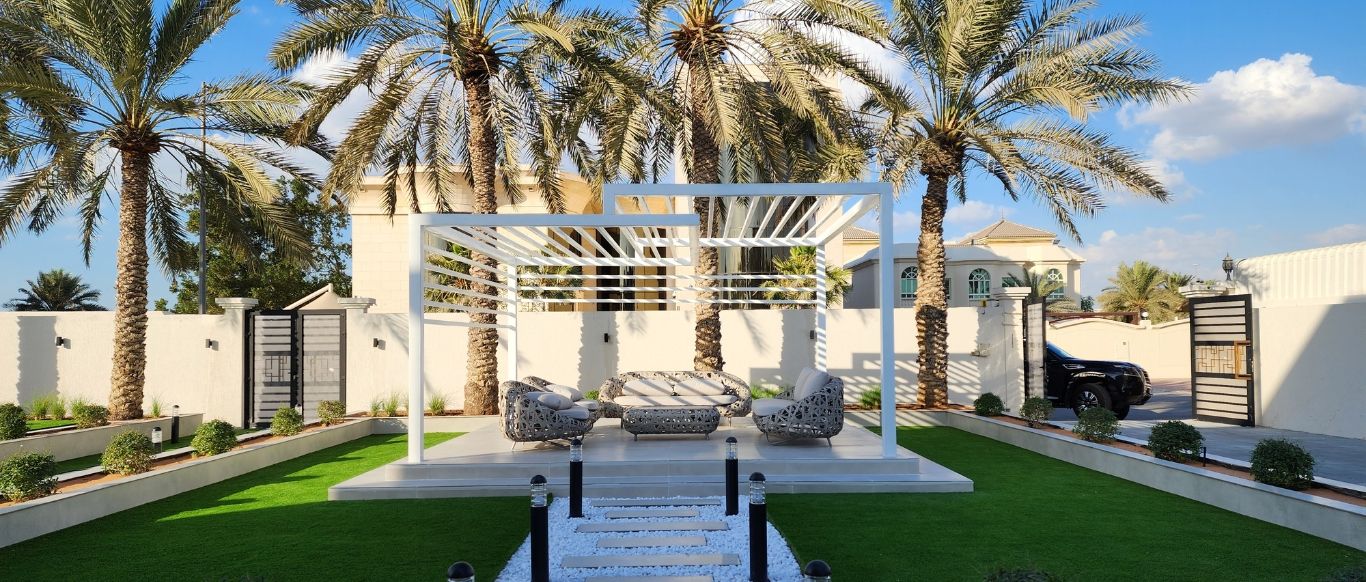
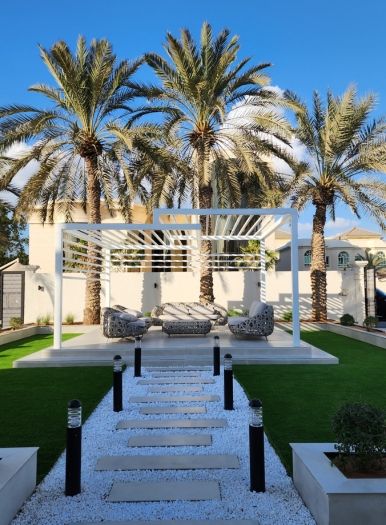
Al Twar, Dubai · Q4 of FY2024A white gazebo at the end of a path of stepping slabs in white pebbles lined with bollard lights, surrounded by lawns, planters and tall palms, in Al Twar, where the outdoor works also included a pool with a cascading water feature and a sunken structure for gatherings.
View project →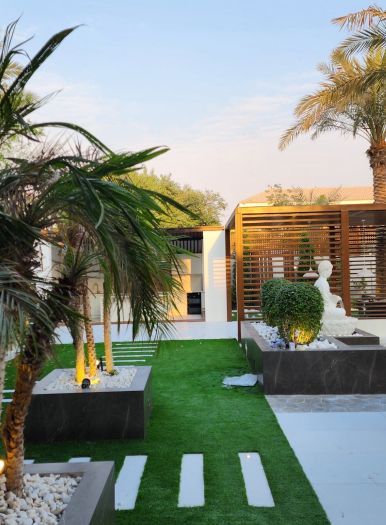
Project Casa Colonia
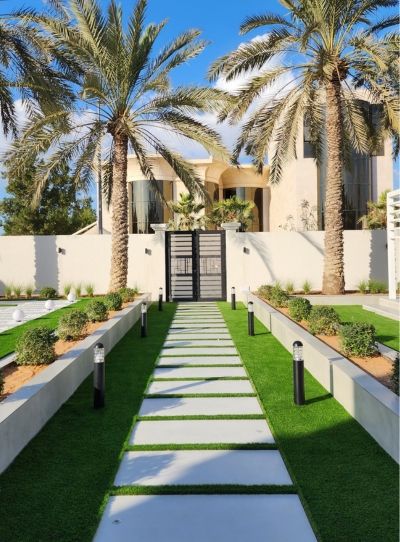
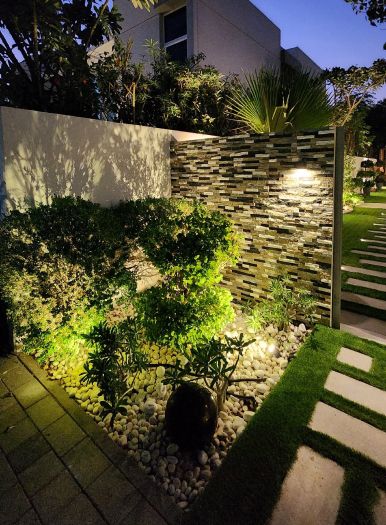
The Villa, Dubai · Approx. 600 sqm · Q3 FY26 to Q4 FY26A lawn crossed by white stepping slabs, dark planters holding palms with white pebbles and uplights, and a slatted pergola screen, from a complete outdoor transformation in The Villa that also included poolside and landscape lighting, a barbecue station and water features.
View project →More of our work: YouTube · Instagram · our Google reviews
Questions and answers
When is the planting season in Dubai?
How often should a Dubai villa garden be maintained?
Why does my garden look so tired at the end of summer?
Should I change the irrigation timer with the seasons?
What should I do after a shamal?
Does artificial grass need maintenance in Dubai?
How do I know the garden needs a redesign rather than maintenance?
More guides
Our related services
Contact Us
Ready to bring
your vision to life?
Get in Touch
We appreciate your interest in OutMazed ® Design and would be delighted to assist you with your design requirements. Our team of professionals are committed to providing you with the highest standard of service and satisfaction possible.
Please feel free to contact us and let us know what you're interested in or looking for. We are here to assist you whether you need help with a new project, renovation, or just some design advice. Fill out the contact form below, and one of our staff will contact you as soon as possible.
Alternatively, you can also reach us via phone or email, and our friendly staff will be happy to help you. We encourage you to take the first step towards transforming your space with OutMazed ® Design by contacting us today.