Common garden problems in Dubai villas, and what to do about them
A villa garden in Dubai lives through months of dry heat on sandy ground, with its water arriving through a pipe rather than from the sky, so most of what goes wrong traces back to water, soil, heat or sand. This guide works through the faults owners see most, from yellow leaves and bare lawn to salt crust, failing irrigation, pests, tired palms and paving that moves.
Free site visit · Approvals handled by us · Designed in 3D
Start with the causes behind most faults
Before treating a symptom, ask what is behind it. Water: too much, too little or unevenly spread, which in a Dubai garden nearly always means the irrigation rather than the weather. Soil: most villa plots sit on sand that drains fast, holds few nutrients and lets salts build up near the surface. Heat: from late spring to early autumn the sun stresses anything planted in the wrong place. Sand and dust: the shamal carries both onto leaves, lawns, paving and light fittings. A symptom often has more than one cause, so look at the whole bed rather than the one plant. What fails in August is usually a decision made in June, which is why our garden maintenance calendar runs the year the other way round. Our garden maintenance team looks at irrigation, planting, lighting and paving on each visit.
Yellowing leaves and plants that look tired
Yellow leaves are the commonest complaint and the most misread. The pattern tells you more than the colour.
Overwatering and poor drainage
Older leaves turning yellow and soft, soil that stays damp and a sour smell at the base point to roots sitting in water. On sand this happens where a run time is too long, a dripper was added beside a thirsty neighbour, or a bed sits below the paving and collects the wash-down. Shorten the run first.
Too little water, or uneven water
Leaves that yellow from the edges, go crisp and drop, usually on one side of a bed or at the far end of a line, mean the water is not reaching them. Check the nearest emitters and the flow at the end of the run.
Salt in the soil and the water
Scorched leaf margins on otherwise green leaves, worse in late summer, often come from salts left behind as water evaporates. An occasional deep watering, mulch and better soil in the bed can all help; frequent shallow watering tends to make it worse.
Nutrients and heat stress
Pale new growth with green veins usually points to a feeding problem, which fast-draining sand makes common. Leaves that wilt in the afternoon and recover by morning are heat stress rather than thirst; shade, mulch and a cooler position help where extra water does not. Our guide to plants that thrive in Dubai covers what copes on its own.
Lawn patches and bare areas
A natural lawn needs more water and attention than anything else in a Dubai garden, so it shows faults first.
Shade
Grass under a tree canopy, along a north-facing boundary wall or beside a pergola thins out and gives up, and feeding does not change that. Let planting take that strip, or lay artificial grass there and keep real turf for the sun; our artificial grass installation page covers the base, drainage and edges it needs.
Compaction and traffic
The route from the kitchen door to the pool or side gate wears bare because the sand under it packs hard and the roots cannot breathe. Aerate it, or accept the route and set stepping stones into it.
Irrigation coverage
A dry crescent at the edge of a spray head's throw, a wet circle around a weeping joint and a green stripe where heads overlap map the system for you. Run each lawn zone in daylight and watch where the water lands before reseeding.
Pests and disease
Patches that spread in rings, turf that lifts like a carpet and dead circles with a dark edge usually mean grubs or a fungal problem, which the humid end of summer encourages. Water early so the grass dries, and have the patch looked at before anything is applied.
The wrong grass
A lawn turfed with a type that wants cool nights struggles through a Dubai summer whatever you do. If it fails the same way every year, the grass is the fault, not the care.
Salty soil, white crust and waterlogging
What the ground under a Dubai garden is like
Most villa plots are sand with a thin layer of imported soil over it, and some are compacted fill left from the building work. Sand drains quickly, holds little water or feed and, as the water evaporates, leaves its salts behind as a white crust on the soil and the pebbles. The crust means water is being applied little and often. Water less often and more deeply, mulch bare soil, and work organic matter into the bed when it is next replanted. Near the coast the planting also has to stand up to salt in the air and wind.
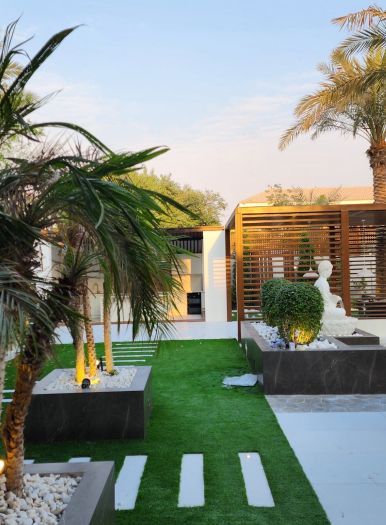
Waterlogging is the opposite fault, and it is common where the levels were never set. A bed lower than the paving around it collects every wash-down, and over compacted fill the water has nowhere to go, so roots rot under what looks like dry sand. Raise the bed, give it a drainage layer or an outlet, and set the falls on the paving so water runs away from the house and the beds. Levels come first when a garden is built properly, which is why our villa garden landscaping sets them and lays pipes and cables before the paving goes down. Raised planters, like the dark planters holding palms at Project Casa Colonia in The Villa, give planting a bed of its own.
New plants dying and irrigation that is quietly failing
A plant put in at the wrong time and a system nobody has watched run often arrive together. Irrigation can be part of our villa annual maintenance.
- Planted at the wrong timeThe planting season in Dubai is the cooler months, roughly October to April. A shrub planted in June has to grow roots through the hottest months with no reserve, and many fail; anything that must go in during summer needs shade and daily attention.
- Planted too deep or too shallowA root ball buried below the surface suffocates in wet sand; one left proud dries out in a day. Set the collar level with the soil and shape a shallow basin so water soaks in at the roots.
- No establishment wateringA new plant needs hand or bubbler watering at its root ball for the first weeks, because a drip line wets the bed around it, not the ball.
- Blocked emittersSand and scale block drippers one at a time, so a bed dies in patches while the controller reports a normal run. Flush the lines, clean the filter and replace emitters that will not clear; see our guide to drip irrigation for Dubai gardens.
- Timers and seasonsA schedule set in March is wrong by June and wrong again by November. Adjust the run times with the season and check the controller after any power cut.
- Pressure, leaks and mixed zonesA wet patch that never dries, a hissing joint, or a zone that dribbles while another floods point to a leak or to mixed zones; a palm and a flower bed on the same line cannot both be right. Our garden irrigation systems page explains how zones follow the planting plan, with sleeves under paths so repairs do not mean lifting paving.
Sand, dust, pests and disease
The shamal brings one set of problems, and the humid end of summer brings another.
Sand after a shamal
Fine sand on leaves, lawn and artificial grass blocks light and holds heat. Hose the planting down early in the morning, brush artificial grass against the pile, and check that path and spike lights are not buried; fittings have to be rated for heat, dust and water, as our outdoor and landscape lighting page sets out.
Dust on paving and pool decks
Pale paving shows dust quickly, and dark paving holds the heat. A wash-down that runs to a drain rather than into the beds keeps both in order.
Mealybug and scale
White cottony clusters in the leaf joints, or small brown bumps on the stems that do not rub off, with sticky leaves below, are sap-sucking insects that spread fast on stressed plants in a sheltered corner. Prune out the worst growth, wash the rest and open up the airflow; a persistent outbreak needs a specialist.
Fungal problems
Spots on leaves, a grey or white powder on new growth and rot at the base of plants follow humid nights, overhead watering and crowded beds. Water at the roots in the morning and thin the planting so air moves through it.
Pests in palms
A crown that yellows from the centre, fronds that collapse and holes or sawdust at the base of the trunk need someone who knows palms, quickly, because by the time the crown fails the damage is inside the trunk.
Palms, trees, artificial grass and the hard landscape
The faults that show in the structure of the garden
Palms and trees are the slowest things in a garden to fail and the hardest to replace. A crown that thins or leans and a trunk that softens at the base need attention now rather than after summer. Roots are the quieter fault: a tree planted close to the boundary wall, the pool or the paving lifts slabs, opens joints and cracks render as it grows, so a garden plan gives trees root room away from walls and the pool. Pruning is done in the cooler months, and cutting a palm back to a few upright fronds weakens it. Artificial grass fails from underneath, with seams that open, a base settled into dips and water sitting under it beside the pool; a poor base is relaid rather than patched. A surface too hot to walk on in the afternoon is a shade problem, and a tree or a custom pergola makes it usable, as it does a west-facing seating area.
Hard landscape moves with the heat. Paving in full sun expands and contracts, so joints open, slabs rock and a path laid without falls holds water against the house after every wash-down. Rendered boundary walls crack where a planter was built against them without a lining and a drain, and cladding fails with the wall behind it, which is why our boundary wall and garden wall work deals with cracks and damp before any finish goes on. Interlock can be lifted and relaid; stone or porcelain on a failed base usually has to come up, and our interlock and paving page explains falls, sleeves and heat underfoot. When the same faults return every year in the same places, the garden has a layout problem rather than a maintenance one. Our landscape design team checks sun, levels, drainage, access and services on a free site visit, shows the new garden in 3D and builds it with the same team, and we apply for the approvals the community or developer requires.
Gardens from our projects
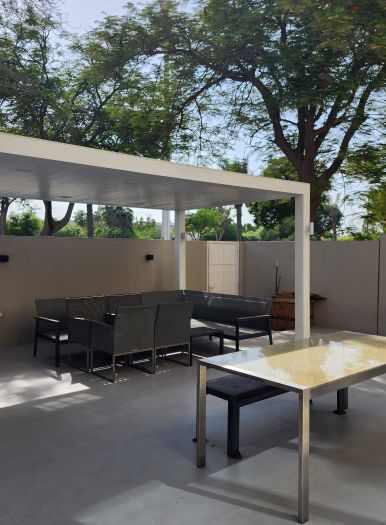
Project Barn
The Springs, Dubai · Approx. 420 sqm · Q4 FY25 to Q1 FY26A complete outdoor redesign in The Springs, in a minimalist design language with weather-resistant material selections, integrated lighting for ambience and night-time use and custom detailing, built by our in-house team.
View project →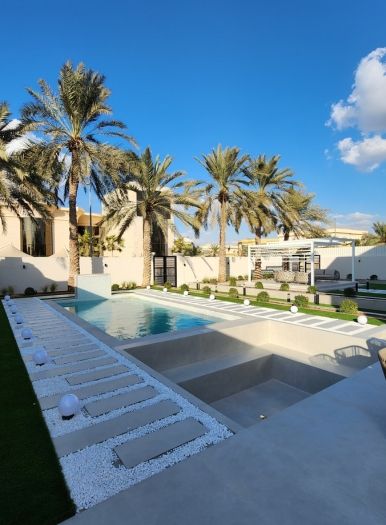
Project Majestic
Al Twar, Dubai · Q4 of FY2024A pool with a cascading water feature, a sunken structure for relaxation and gatherings and a gazebo, part of a full indoor and outdoor transformation in Al Twar that also included a custom-built parking area.
View project →More of our work: YouTube · Instagram · our Google reviews
Questions and answers
Why are the leaves on my plants turning yellow?
Why does my lawn go bare in the same places every year?
What is the white crust on the soil?
Why did my new plants die within weeks?
How do I know if the irrigation is the problem?
What should I do in the garden after a shamal?
When is a garden problem a design problem?
More guides
Our related services
Contact Us
Ready to bring
your vision to life?
Get in Touch
We appreciate your interest in OutMazed ® Design and would be delighted to assist you with your design requirements. Our team of professionals are committed to providing you with the highest standard of service and satisfaction possible.
Please feel free to contact us and let us know what you're interested in or looking for. We are here to assist you whether you need help with a new project, renovation, or just some design advice. Fill out the contact form below, and one of our staff will contact you as soon as possible.
Alternatively, you can also reach us via phone or email, and our friendly staff will be happy to help you. We encourage you to take the first step towards transforming your space with OutMazed ® Design by contacting us today.