Cleaning artificial grass in Dubai and keeping it pet friendly
Artificial grass needs no mowing or watering, but in Dubai it is not maintenance free. Sand settles into it, the summer sun heats it, and a dog uses it every day. This guide covers how to brush, rinse and check an artificial lawn through the year, what to ask for in a pet-friendly product, and the signs that it is time to replace it.
Free site visit · Approvals handled by us · Designed in 3D
What an artificial lawn in Dubai actually asks of you
Compared with a natural lawn, an artificial one asks little: no mowing, no feeding, no watering through the summer. What it still needs is cleaning, because a Dubai garden is not a clean place. Wind carries fine sand over the boundary wall and into the pile, dust from building sites settles on it, birds use it, and a family dog treats it as its own. None of this harms a good product if it is dealt with regularly; all of it harms a lawn left alone for a season. A brush and a hose do most of the work, and a seasonal check of the joins and edges does the rest. Our guide to artificial grass types and quality explains pile, yarn, backing and infill, and our artificial grass installation page explains how we lay it as part of a designed garden, with the base, edges and drainage built by the same in-house team.
Sand and dust: why the lawn gets dull and hard
Brush it, then rinse it, in that order
In most climates rain washes a lawn. In Dubai months pass without it, so whatever lands on the grass stays there. Fine sand works down between the fibres and, left alone, packs into a crust on the backing that stops water draining, holds heat and flattens the pile from below. Dust dulls the fibres, so a green that looked rich in spring looks grey by the end of summer. Gardens near open desert, new construction or a busy road collect more. The fix is mechanical before it is wet: a stiff brush with synthetic bristles, never wire, pulled against the direction of the pile lifts the fibres and loosens the sand so it can be swept or blown off. Brushing with the pile only pushes it down.
Once the loose sand is off, a rinse with the hose washes the dust from the fibres and carries the fine material through the backing, which is what the drainage holes are for. Rinse in the evening or early morning and let the lawn drain before anyone walks on it. If the backing shows when you part the pile after a heavy brush, the infill needs refreshing, because the infill keeps the fibres upright and shields the backing from the sun. Stepping stones set into the grass, as at Project Alpha in Damac Hills 2, collect sand along their edges, so brush those joints first. For the rest of the garden's seasonal jobs, our garden maintenance calendar sets out what to do and when.
Heat: keeping the surface usable in summer
Artificial grass does not cool itself the way a living lawn does. In full afternoon sun the fibres get hotter than the air, enough to be uncomfortable for bare feet and a dog's paws. These are the things that bring the surface temperature down.
Shade over the part you use
Keeping the sun off the lawn changes its surface temperature more than anything else. A pergola, a shade sail, a tree or a wall that casts afternoon shadow makes the difference between a lawn the children use and one they cross quickly. When a garden is planned as outdoor rooms, the lawn goes where the shade will fall at the hours the family is outside, with a route to it in pale paving, which stays cooler than dark tile, so nobody crosses hot grass to reach it.
A rinse before use
Wetting the lawn briefly with the hose drops the surface temperature sharply, and the effect usually lasts into the evening. Water draining through the backing takes heat with it, another reason to keep the drainage holes clear.
Lighter and mixed tones
Dark, single-tone grass absorbs more sun than a lighter mix of greens with a pale thatch. If the lawn is still to be chosen, compare this in the samples; if it is already down, a pale infill helps a little.
Dogs on artificial grass: drainage, infill and smell
A dog puts more demand on an artificial lawn than anything else in the garden, and is the reason most owners ask about cleaning. The product, the base and the routine all have to be right.
- How fast the backing drainsUrine must pass through the grass and base and away, or it sits on the backing and smells. A pet lawn needs a backing that drains across its whole area, not only through a few punched holes, over a base that drains freely. On a lawn that is already down, pour a bucket of water where the dog goes and watch: if it puddles, the problem is usually the base or packed sand rather than the grass.
- The infill underneath the fibresOrdinary sand infill holds moisture and, with it, the bacteria that cause smell. Pet lawns generally use an infill made for the purpose: coated granules that do not hold urine, or mineral infills that bind the odour-causing compounds until they are rinsed through. Either way, it should drain rather than soak and be refreshable without lifting the grass.
- Rinsing and enzyme cleanersHosing the area the dog uses regularly through summer matters most, because water carries the urine through before it dries. When a smell has set in, an enzyme cleaner, a liquid whose enzymes break down the proteins in urine rather than masking them, is normally sprayed on, left to work and rinsed off. Avoid bleach and strong disinfectants, which can discolour the fibres.
- Scratching and diggingA dog rarely digs through a well-made artificial lawn, but a bored dog may scratch at the edges and work at a loose seam until it lifts. Firm edges fixed against paving or a concealed edging, seams glued on tape rather than only pinned, and a dense pile with a strong backing all resist this.
- What to ask for in a pet-friendly productA backing that drains across its whole area, an infill made for pets, a resilient shaped yarn that stands up again after being trodden, a strong tuft bind so paws do not pull fibres out, a medium or short pile that is easy to brush and rinse, and a colour that will not change with repeated cleaning. Mention the dog at the free site visit, which looks at how the area will be used.
Stains, weeds, flat pile and the damp corner
Beyond sand and the dog, a Dubai lawn picks up a handful of smaller problems through the year. Each has a simple answer if it is caught early.
Food, drink and grease
Most spills from a barbecue or a children's party rinse off with water and a little mild detergent, brushed through the pile and hosed away; sugary drinks attract ants, so deal with them the same day. Cooking oil does not rinse off: blot it, work in a mild degreasing detergent, brush, rinse and repeat, and keep the barbecue on paving rather than grass.
Bird droppings
Common under palms and beside a pool. Let them dry, lift the solids, then rinse; scrubbing them wet spreads the stain, and they are acidic, so do not leave them on a pale thatch.
Weeds at the edges
Weeds rarely grow through a good membrane, but they root in sand blown onto the surface and along the edges where the grass meets a bed or a wall. Pull them while small and keep the edges brushed.
Flattened pile
Furniture legs, a paddling pool and the route everyone walks press the fibres down. Brush against the pile to stand them up, move furniture now and then, and put a slab or deck under anything that stays put. Under a swing or climbing frame it wears faster still, which is why EPDM and rubber play flooring suits the ground beneath play equipment.
Moss and algae in damp corners
A corner that never gets sun, beside a pool or a dripping tap, or where a sprinkler throws water over the grass, grows a green or black film on the fibres. Fix the water first: redirect the sprinkler, repair the leak, make sure the base drains. Then brush off the film and rinse with a dilute, lawn-safe cleaner. Drip lines to the beds rather than sprinklers keep the garden irrigation where it belongs.
Small gardens, balconies and the end-of-summer check
Where the lawn is small, the dog uses all of it
In a townhouse garden or on an apartment balcony there is no spare lawn to rotate the dog onto, so the whole surface takes the use, and drainage, a short cleanable pile and a frequent routine matter more than softness. On a balcony the grass sits on tile or screed rather than a free-draining base, so rinse water has to reach the balcony drain, which the grass and its edges must not block; a balcony lawn is usually held at the edges or with adhesive rather than pinned. The building management may have rules about water running off the balcony, so check before the first rinse. Where the garden is a narrow strip, our small garden ideas for townhouses cover how to give the dog and the family separate ground.
Whatever the size of the lawn, walk it at the end of summer, when the heat and the dry months have done their work. Run a hand along every seam: a join that has opened even slightly will catch a paw and widen. Press the edges where the grass meets paving, beds and the pool deck; an edge that lifts needs re-fixing before sand gets under it. Look for ripples, which usually mean the grass has expanded in the heat and is not held firmly, and for low spots where the base has settled and water will sit. A lawn brushed and rinsed through the summer passes this check quickly; one that has not is where the repair list begins.
When to repair, when to replace, and what a maintenance visit does
Most problems on an artificial lawn are fixable without lifting it. A few are not, and knowing the difference saves money either way.
Repair it when
A seam has opened, an edge has lifted, the infill has thinned, a small area is stained or burnt by a dropped coal, or one patch is flattened. Seams are re-taped and glued, edges re-fixed, infill refreshed, and a damaged patch cut out and replaced with a matching piece laid with the pile in the same direction.
Replace it when
The fibres have gone pale and brittle and break off when brushed, the backing is cracking or tufts pull out across the whole lawn, the base has sunk so the lawn puddles in several places, or the smell from a pet area no longer clears after an enzyme clean and a deep rinse, which means it has reached the base. Replacing it is the point at which to fix the base and drainage properly.
Consider a different surface
If the problem is heat in a lawn with no possible shade, or a dog that will not leave the edges alone, the answer may be a smaller area of grass with more paving and planting, or a natural grass lawn in an irrigated, sunny part of the garden with artificial grass kept for the shaded corner. The right mix is a landscaping design question rather than a cleaning one.
What a maintenance visit covers
As part of garden maintenance in Dubai, our team brushes the artificial grass, removes debris and sand, checks the joins and edges and keeps the surface clean around pools and play areas, alongside the irrigation, planting and lighting in the same garden. We look after gardens we did not build as well, and the scope is agreed after a free site visit. The same brushing and infill care applies to a putting green, whose shorter, denser turf is laid so the ball rolls true.
Artificial grass in our projects
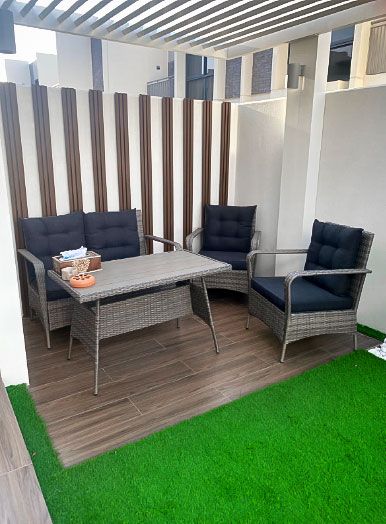
Project Alpha
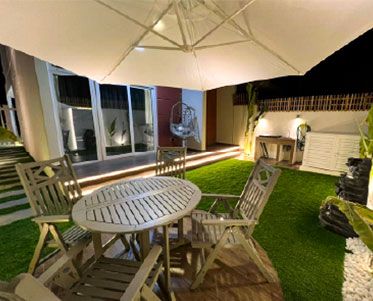
Damac Hills 2, Dubai · 200 sqm · November 2022 - December 2022An outdoor seating corner with a woven-look sofa, armchairs and a table with navy cushions on a wood-look deck edged by artificial grass, with vertical slat panels on the wall and a white slatted shade structure overhead. Project Alpha in Damac Hills 2 combined fake grass with stepping stones, wall cladding and ambient lighting.
View project →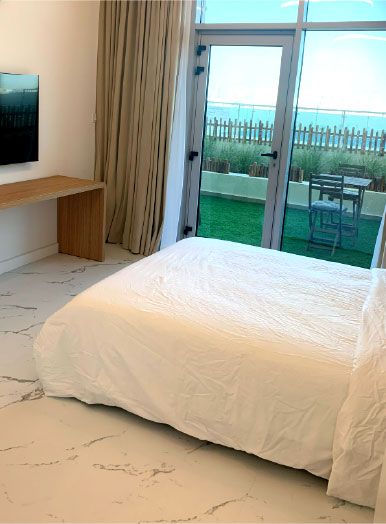
Project Wonder
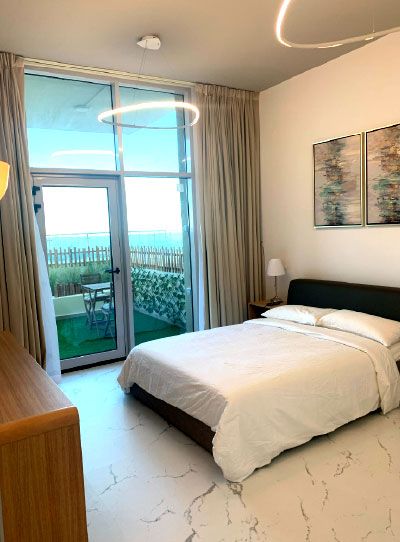
Al Furjan, Jebel Ali · 110 sqm · May 2021 - June 2021A bedroom glass door opening onto a balcony with green turf, planted troughs, a wooden picket fence and a table with chairs. Project Wonder in Al Furjan was a makeover whose scope ran from the kitchen and bathrooms to balcony landscaping.
View project →More of our work: YouTube · Instagram · our Google reviews
Questions and answers
How often should artificial grass be cleaned in Dubai?
Can I use a pressure washer on artificial grass?
How do I get rid of a dog urine smell on artificial grass?
Is artificial grass too hot for dogs in a Dubai summer?
Why is there moss or algae on my artificial grass?
Can a damaged patch of artificial grass be repaired?
Do you maintain artificial grass you did not install?
More guides
Our related services
Contact Us
Ready to bring
your vision to life?
Get in Touch
We appreciate your interest in OutMazed ® Design and would be delighted to assist you with your design requirements. Our team of professionals are committed to providing you with the highest standard of service and satisfaction possible.
Please feel free to contact us and let us know what you're interested in or looking for. We are here to assist you whether you need help with a new project, renovation, or just some design advice. Fill out the contact form below, and one of our staff will contact you as soon as possible.
Alternatively, you can also reach us via phone or email, and our friendly staff will be happy to help you. We encourage you to take the first step towards transforming your space with OutMazed ® Design by contacting us today.