Pool covers for Dubai villas: types and how to choose
A villa pool in Dubai sits under strong sun in dry air, in a garden where the wind carries sand and the palms drop fronds, and it is chilled in summer and often heated in winter. A cover works on all of those at once, but only if it suits the pool's edge, has somewhere to live and gets used. This guide covers the cover types, how the edge decides what fits, where the roller goes in a new or an existing pool, and how a cover, a chiller and a heater work together.
Free site visit · Approvals handled by us · Designed in 3D
Why a cover earns its place on a Dubai pool
An open pool in Dubai loses water to the air all year, and more heavily in summer, when the water is warm, the air is dry and a breeze runs across the surface. A cover closes that surface, so the automatic fill runs less often, the water a chiller has cooled stays cooler for longer and the sun burns off less chlorine. It also keeps the pool cleaner: wind carries sand and dust into every villa garden, date palms drop fronds and seed, and a pool left open overnight starts the morning with a film on the water. Which cover suits you depends on the pool's shape and edge, where the roller can hide and how the family uses the water, so it is decided with the pool rather than bought afterwards. For a new pool, our swimming pool construction team plans the pool, deck, shade and planting together and shows them in 3D before work starts, so a cover housing can be planned with the pool. Shade and warm water are covered in our pool chillers and cooling guide.
Cover types, in general terms
Start from the problem you want solved: evaporation and temperature, dirt, safety or the look of the garden.
Manual thermal and bubble covers
A floating sheet of bubbled or foam plastic cut to the pool outline and wound onto a free-standing roller. It is the simple way to cut evaporation and hold temperature, but the handling means it often stays off after the first season, the roller sits on the deck and it is not a safety cover.
Slatted automatic covers
Rigid interlocking slats float on the water and wind onto a motorised drum at one end of the pool at a key switch. Closed, they hold temperature and keep sand and leaves out. The drum sits above the deck inside a bench, or below the water in a recess planned at the drawing stage.
Hidden roller systems planned at build stage
The drum lives in a chamber at one end of the pool under a lid of paving, a grille or a bench, so nothing shows when the pool is open. The chamber needs a drain, power and access, and that end of the pool must be a clean rectangle, so it is decided on the first drawing.
Mesh and solid safety covers
A taut sheet of mesh or reinforced fabric anchored into the deck and tensioned so that it bears weight. Mesh lets rain and dust through; a solid sheet keeps them out. Both go on by hand, so they suit a pool closed for the summer holidays rather than one covered nightly; our pool fence and safety guide covers the other layers.
Retractable decks and hard covers
A section of deck that slides over the water on rails turns the pool into a terrace when closed; a rigid hinged cover does the same at a smaller scale. Both are design features as much as covers, need a structural design and a flat run of deck to park on, and suit a garden where pool and entertaining space compete for the same ground.
Fitting a cover to the edge you have
Skimmer, overflow and infinity edges each ask something different
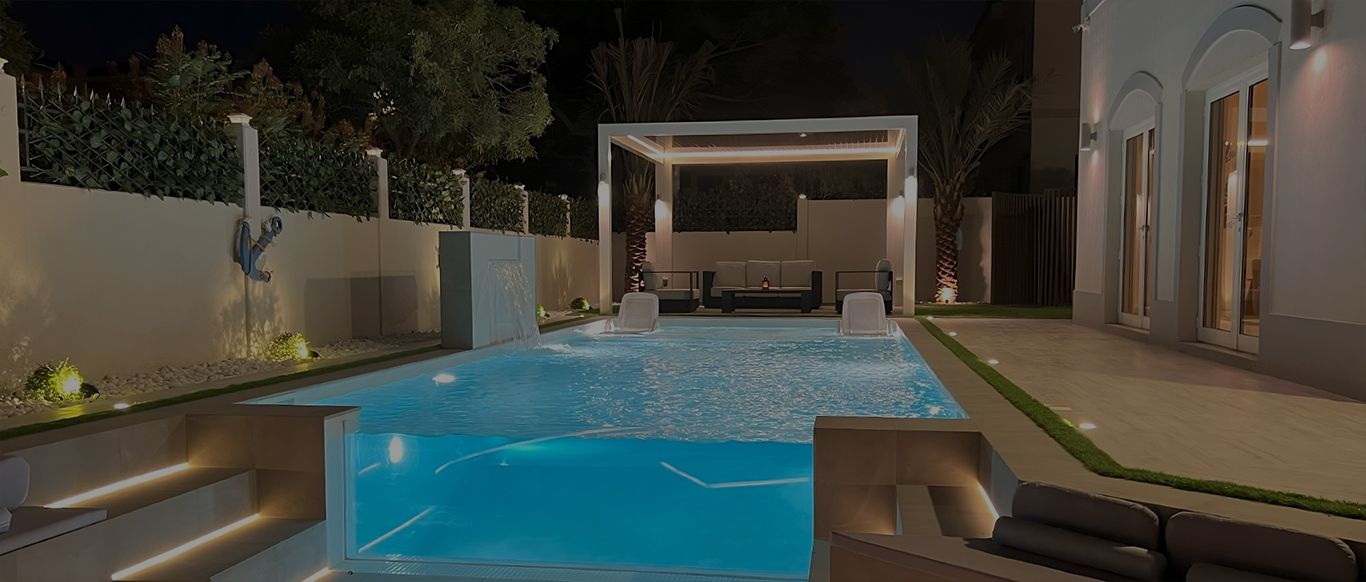
On a skimmer pool the water line sits a short way below the coping, so a floating cover has a wall to rest against, slats run under the coping and a safety cover anchors into the deck. A clean rectangle is the easier outline, because every cover is made to it and a curve, a rounded end or corner steps leave a gap or need a shaped piece. A glass corner panel, as at Project Miracle in The Villa, changes nothing as long as the water line and coping run level past it.
On an overflow pool the water sits level with the deck and spills into a channel around the edge, so there is no wall for a floating cover to sit inside and nothing to stop slats riding over the grating. The answers are a cover that lies on the deck, anchored outside the channel, or an automatic system on its own guide rails, with the overflow set for the closed hours. An infinity edge is harder still: the spill wall sits lower than the water, so the cover stops short of it, usually from a hidden roller at the house end, and all of this is settled with the pumps and balance tank before the shell is cast.
Planning the housing in a new pool
Whether a cover gets used usually comes down to where the roller lives. The housing is fixed at the design stage with the balance tank and plant room; our guide to pool construction stage by stage shows where that falls.
- A recess at the end of the poolA chamber in the shell at one end, below the water line, holds the drum under a lid or grille of paving, so the pool reads as one clean rectangle. It needs a drain so it does not fill with sand, a lid that lifts for servicing and extra length on the pool.
- Under a deck or a benchWhere the plot is short, the drum sits above the water inside a bench, planter wall or raised deck and the cover runs down over the end wall; the bench becomes the seat at the shallow end and hides the motor.
- Power, controls and the plant roomAn automatic cover needs a protected power feed, a key switch where an adult can see the whole pool as it closes, and a motor that can be reached, all drawn under the deck with the pool lighting and the other services.
- The outline, the steps and the copingSquare corners, steps along the end wall rather than jutting into the water and a coping with a flat underside all help a cover fit and last; a free-form shape narrows the choice to a manual sheet or a safety cover cut to the curve.
- Waterproofing the housingA recess below the deck is a tank in its own right, lined and tested with the shell, with the drain and cable penetrations detailed before any finish goes on, because that is where leaks start. Our page on waterproofing for villas explains how pool shells and balance tanks are treated.
Retrofitting a cover to an existing pool
Many villa pools in Dubai came with the house, built to a plan with no thought for a cover. One can still be added, within limits.
What is easy
A manual thermal cover on a free-standing roller, or a tensioned safety cover anchored into the deck, fits almost any pool and needs no building work beyond the anchor holes.
What is limited
An automatic cover on an existing pool usually means a bench housing or a drum above the deck, because cutting a chamber into a finished shell is a structural job. A free-form shape, corner steps and a raised spa spilling into the pool narrow the choice further.
Use a renovation as the moment
When the finish, coping or deck is being renewed anyway, the end wall can be rebuilt with a chamber and the steps moved to suit a cover. Our swimming pool renovation page covers what an existing pool can take, and a turnkey pool renovation runs shell, waterproofing, equipment, finish and deck in one sequence, so the housing is built at the right stage.
Check with the community
Where a housing changes the pool outline or adds a structure above the deck, the developer or community management may require a no-objection certificate first. For the pools we build or renovate, we apply for the approvals ourselves.
What a cover does for the water, and for the garden
Cover, chiller and heater work as a set
A chiller fights the sun and the air, and a cover takes away part of what it has to fight. In summer a pale, reflective cover by day keeps some of the sun's heat out, and the pool is left open at night so heat can escape to the sky. In winter the reverse: a heat pump warms the water and a dark or insulating cover kept on overnight holds that warmth in. A cover that stays off does nothing, and the wrong colour at the wrong hour warms water you are trying to cool, so the routine is agreed at handover and kept to.
A cover also changes how the garden reads. Closed slats turn the pool into a flat pale floor, so their colour is chosen with the deck, while a hidden roller keeps the open pool looking as it was drawn. Shade helps a cover rather than replacing it: a pergola along one side keeps the afternoon sun off the slats as well as the loungers, and our custom pergolas are planned in 3D around the sun and the layout. Pool, cover, deck, shade and planting settle more easily together, as rooms, which is how our outdoor living page treats a villa garden.
Materials, cleaning and safety habits
A cover in Dubai lives in strong sun, hot dry air, wind-blown sand and chlorinated water. Material and care decide how long it lasts.
- Materials that cope with UV, heat and chlorineAsk for a UV-stabilised material rated for the water temperatures a Dubai pool reaches in late summer; pale colours run cooler than dark ones. Rails, fittings and anchors in marine-grade stainless steel or coated aluminium resist chlorine and salt air; plain steel does not. A thermal sheet left folded in the sun is finished in a season, so keep it on its roller in the shade.
- Keeping sand off and outBrush or hose the closed cover before opening it, so the sand does not slide into the pool, and rinse it with fresh water now and then. A chamber or bench housing collects sand too and is cleared through the year; our garden maintenance service covers paving and pool decks as well as planting.
- Chemistry under a coverA covered pool loses less chlorine to the sun, so the dose comes down and the water is tested rather than assumed, because chlorine that drifts high under a cover attacks the plastic from below. Gas collects under a closed cover, so open it for a while before anyone swims and never close it straight after a shock treatment.
- Safety: a cover is one layer, not the barrierA weight-bearing cover protects the pool only when it is closed and fixed; a floating thermal sheet protects no one, since a child who steps onto it goes under. No cover replaces an adult watching the water or a fence with a self-closing gate between house and pool. Which covers count as safety covers depends on rating and fixing, so take advice from the supplier and a pool safety specialist before relying on one, and keep the key switch out of children's reach.
Villa pools from our projects
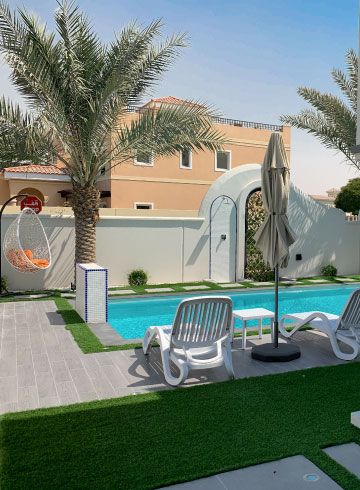
Project Jewel
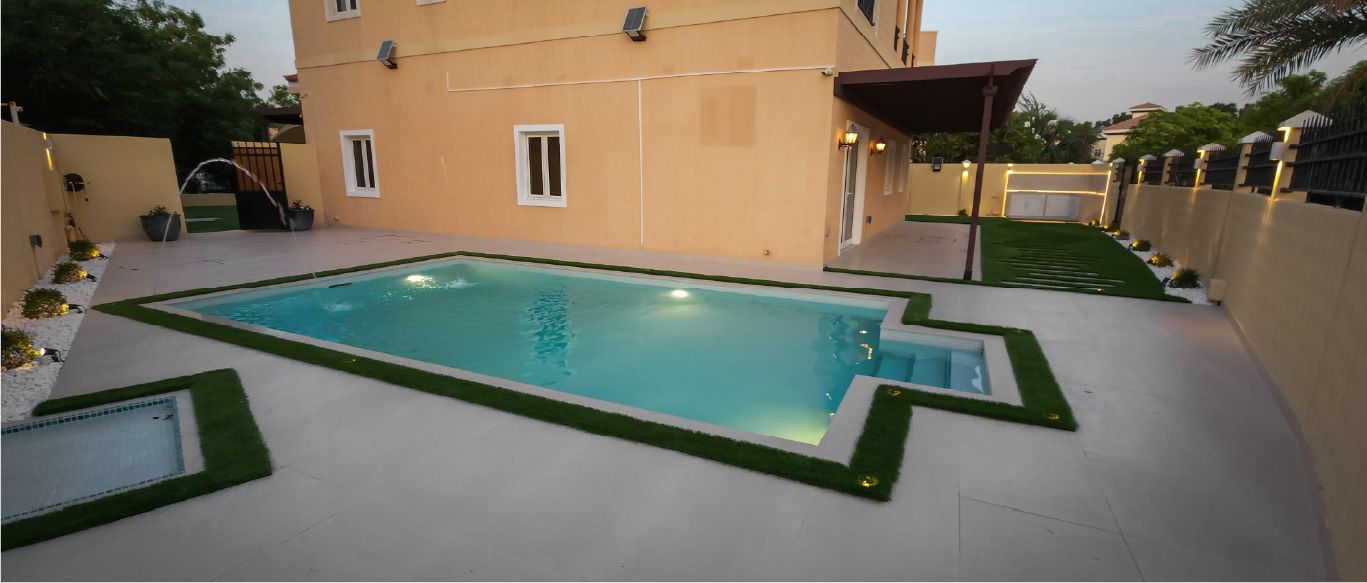
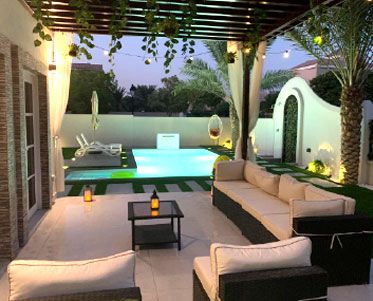
The Villa, Dubai · 750 sqm · February 2020 - July 2020A skimmer pool in new landscaping, with white sun loungers on plank-look paving, a lawn strip, an outdoor shower on the arched garden wall and a hanging egg chair under a palm, part of a villa makeover in The Villa that also included a new kitchen, lighting, remodelled bathrooms and covered parking.
View project →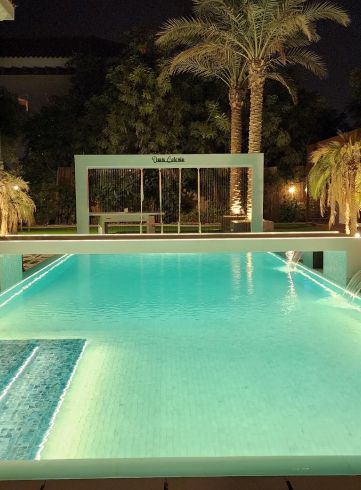
Project Casa Colonia
The Villa, Dubai · Approx. 600 sqm · Q3 FY26 to Q4 FY26A pool lit from below at night, with a mosaic-tiled section edged by LED lines, water jets arcing in from the side and a white bridge at the far end, part of a complete outdoor transformation in The Villa with underwater and perimeter LED lighting, a custom-built BBQ station, pergola zones, rain showers, swings and water features, delivered by our in-house team.
View project →More of our work: YouTube · Instagram · our Google reviews
Questions and answers
Does a pool in Dubai really need a cover?
Can an overflow or infinity pool have a cover?
Can I add an automatic cover to an existing pool?
Do I still need a chiller if I have a cover?
Is a pool cover enough to keep children safe?
How do I look after a cover in the Dubai climate?
More guides
Our related services
Contact Us
Ready to bring
your vision to life?
Get in Touch
We appreciate your interest in OutMazed ® Design and would be delighted to assist you with your design requirements. Our team of professionals are committed to providing you with the highest standard of service and satisfaction possible.
Please feel free to contact us and let us know what you're interested in or looking for. We are here to assist you whether you need help with a new project, renovation, or just some design advice. Fill out the contact form below, and one of our staff will contact you as soon as possible.
Alternatively, you can also reach us via phone or email, and our friendly staff will be happy to help you. We encourage you to take the first step towards transforming your space with OutMazed ® Design by contacting us today.