Pool chillers and pool cooling in Dubai
Water in an unshaded Dubai pool gets uncomfortably warm in summer, in the months you most want to use it. This guide explains why, what shade, finishes and moving water can do before any equipment is added, and how a pool chiller or heat pump works when it is planned as part of a pool project we build or renovate.
Free site visit · Approvals handled by us · Designed in 3D
Why a Dubai pool gets too warm in summer
A swimming pool is a large, flat sheet of water lying open to the sky, and in summer that makes it a solar collector. Sunlight passes into the water and is absorbed by the floor and walls, which warm the water from below as well as from the surface. The air stays hot through the night for much of the summer, so the water gives back little of that heat overnight, and each day starts a little warmer than the last. Shallow water warms faster than deep water, a dark finish absorbs more sun than a pale one, and paving and walls around the pool store heat all day and radiate it back in the evening. There are two answers, and they work together: design the pool and its surroundings to gain less heat, then add a pool chiller to remove the heat that remains. Both are decisions for the design stage of swimming pool construction, alongside the shapes and edges in our swimming pool design ideas, which is why we treat cooling as part of the pool brief from the first site visit.
Passive cooling: what to design in before any machine
Shade over part of the water
A pergola, a shade sail or a louvred roof over one end of the pool cuts the direct sun on the surface for part of the day and gives swimmers somewhere to stand out of it. Shade usually does more than any other passive measure, and it also protects the deck and the furniture.
Pale interior finishes
A light-coloured tile, plaster or mosaic reflects more of the sun's energy than a dark one. Dark finishes give a mirror effect in the evening but warm the water more, so on an exposed site the interior colour is a cooling decision as much as a visual one.
Depth and volume
A deeper pool holds a body of cooler water below the warm surface layer and changes temperature more slowly. A shallow wet deck or a small plunge pool warms quickly in full sun, which is worth knowing before you choose the shape.
Moving water and aeration
Fountains, sheet waterfalls, deck jets and bubblers throw water into the air, where some of it evaporates and carries heat away, and they mix the warm surface layer down into the pool. The effect is strongest on dry days and weaker in the humid weeks of late summer, and it brings sound and movement to the garden.
Covers, used the right way round
A cover is a cooling tool only when it blocks the sun. A light-coloured or reflective cover over the water in the daytime keeps much of the sun out, though it also stops the evaporation that cools the surface, so the gain is modest, while leaving the pool uncovered at night lets heat escape to the sky. A dark or insulating cover left on at night keeps the heat in.
Surroundings that stay cool
Lawn, planting and pale paving around the pool store less heat than dark stone and bare walls. A rinse at an outdoor shower before a swim keeps the water cleaner too, so the filter and any chiller carry less load.
What a pool chiller is
A heat pump that moves heat out of the water
A pool chiller does not make cold; it moves heat. It is a heat pump: a sealed refrigerant circuit with a compressor, a fan and two heat exchangers, one in contact with the pool water and one with the outside air. Water is diverted from the filtered return line through the water-side exchanger, gives up some of its heat to the refrigerant and goes back to the pool slightly cooler. The refrigerant carries that heat to the air-side exchanger, where the fan blows it out as warm air. Repeated for every hour the unit runs, that exchange brings the water down to the temperature the controller holds.
Because the chiller only treats water that passes through it, it depends on the circulation system. It sits after the filter and before any chemical dosing, with a bypass so the flow can be set and the unit isolated without stopping the pool. That is why it belongs in the plumbing drawings, and why we fit chillers and heat pumps only as part of a pool project we build or renovate, where the pipework, the equipment room and the electrics are designed together.
How a heat pump works in both directions
The same machine can cool in summer and heat in the cooler months. Understanding the parts makes the choice between a chiller, a heater and a reversible unit much clearer.
- The refrigerant circuitA refrigerant boils at a low temperature, absorbing heat as it turns to vapour, and releases that heat when it is compressed and condenses back to liquid. The compressor drives this cycle and uses most of the power.
- Cooling modeThe refrigerant takes heat from the pool water in the water-side exchanger and releases it to the outside air through the fan coil. The unit blows warm air while it runs, which is why its position and airflow matter.
- Heating modeA reversing valve swaps the roles of the two exchangers, so the refrigerant draws heat from the outside air and passes it into the water. Dubai's mild winter air holds plenty of heat, so a heat pump heats a pool efficiently without burning anything.
- The controllerA thermostat on the water side switches the unit on and off around the set point. On a reversible unit it also decides which mode to run, so the pool stays within the comfort band through the year.
Where the unit sits: planned at build
Space and airflow
The unit needs clear space around it so the fan can draw in air and push warm air away without pulling it back in. A tight corner or an unventilated plant room makes it work harder.
Noise
A fan and a compressor make a steady hum. We place the unit away from bedroom windows, outdoor seating and the neighbour's boundary where we can, and use plant room walls or a screened enclosure to soften the sound. Some communities set rules on where equipment can stand.
Power
A chiller needs its own protected electrical circuit from the villa's distribution board, sized for the compressor's starting load. It is run with the rest of the pool electrics while the trenches are open.
Plumbing
Flow and return connections, isolation valves and a bypass are set into the pipework between the filter and the pool returns. The flow through the unit is part of the hydraulic design, and the pipe runs decide where the unit can go.
Drainage and access
In heating mode the air-side coil runs cold and sheds condensate in humid weather, so the unit stands on a base that drains, and its valves and isolator are kept reachable without moving furniture or planting.
Sizing is done at design, not from a catalogue
How large a chiller a pool needs depends on the volume of water, the surface area exposed to the sun, the depth, the orientation of the garden, the shade over the water, the interior finish, how warm the owners want the water and how many hours a day the pool circulates. A plunge pool under a pergola and a long, open pool in full sun ask very different things of the equipment. An overflow pool adds a balance tank and a wide, moving surface, which changes the volume to treat and the evaporation, while a skimmer pool has the simplest hydraulics to connect into. The compact townhouse pools in our small pool ideas warm quickly because they are shallow and walled in, but are also quick to cool. We size the pump, the filter and the chiller together from these factors, so the result is a specification for your pool rather than a figure from a brochure, and we do not publish capacities or model numbers.
Running a pool chiller sensibly
Let the design do the work first
A chiller only removes the heat the pool gains, so every passive measure that reduces the gain means fewer running hours. A pool with shade over part of the surface, a pale finish and a fountain running in the evening needs its chiller far less than a bare, dark pool in full sun. Set the thermostat to comfortable rather than cold; the gap between refreshing and chilly is small, and extra cooling is paid for in compressor time. The unit also works more easily at night, when the air it exhausts into is cooler, so running the circulation through the evening and early morning suits both the chiller and the filter.
Keep the air-side coil clear of leaves, dust and sand, and keep the water balanced so the water-side exchanger stays free of scale. These are the same habits that keep the pump and filter in good order, and they are covered in the handover notes at the end of every pool project. If a chiller is being added to an existing pool, that happens within a pool renovation, where the pipework, the electrics and the equipment area are reviewed as a whole rather than a unit being squeezed in beside an old pump.
Chiller only, heater only, or both
Chiller only
For owners who swim mainly in summer and leave the pool to the weather for the rest of the year, a cooling-only unit is the simplest choice, sized for the hottest months.
Heater only
Some owners want warm water on winter evenings and rely on shade and water features in summer. A heat-pump heater suits that pattern and makes the pool usable through the cooler months.
Reversible heat pump
A single reversible unit cools in summer and heats in winter from the same connections and the same supply. It is the usual choice for a villa pool the family wants to use all year, and it takes little more space than a single-purpose unit.
Combined with shade and water features
Whichever unit you choose, the pergola, the finish and the fountain are partners to it, not alternatives. Equipment and surroundings are weighed together in the design and appear together in the quote, as our guide to what drives swimming pool cost explains.
Pools from our projects
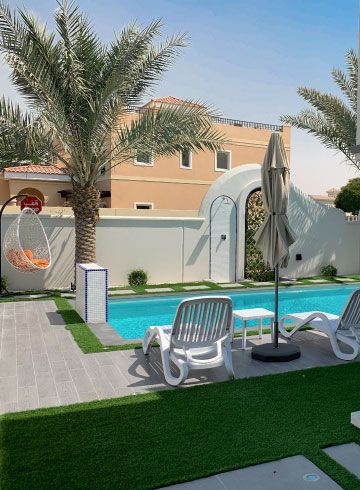
Project Jewel
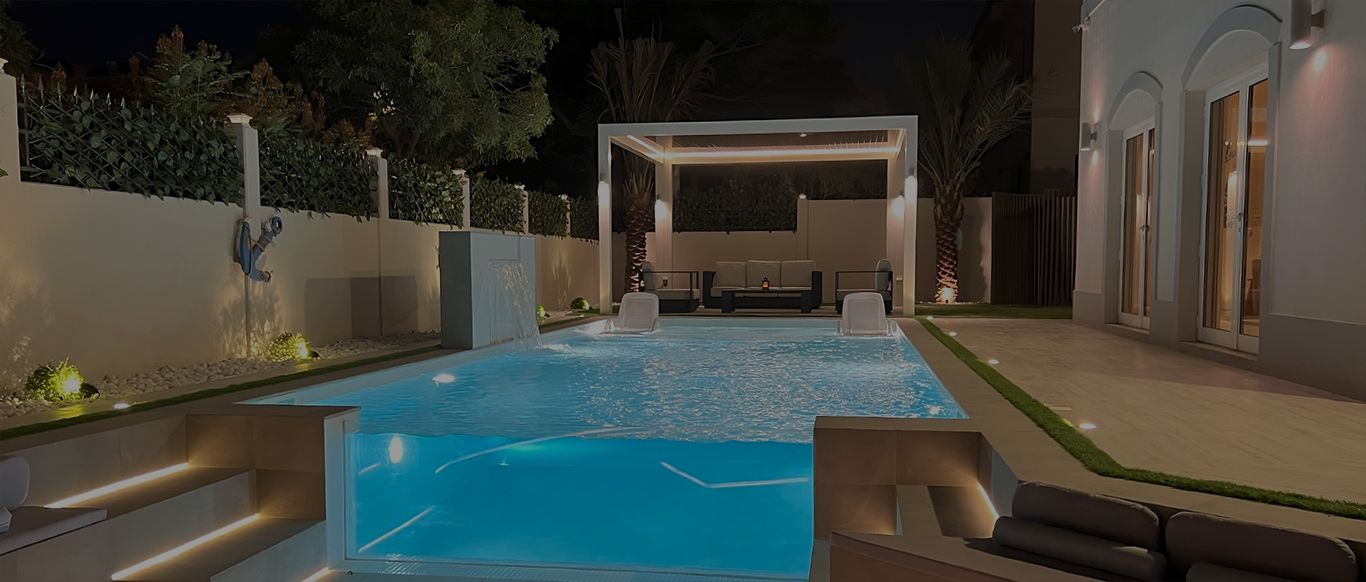
The Villa, Dubai · 750 sqm · February 2020 - July 2020A rectangular pool in The Villa with white sun loungers, a parasol, a hanging egg chair under a palm and an outdoor shower on the arched garden wall.
View project →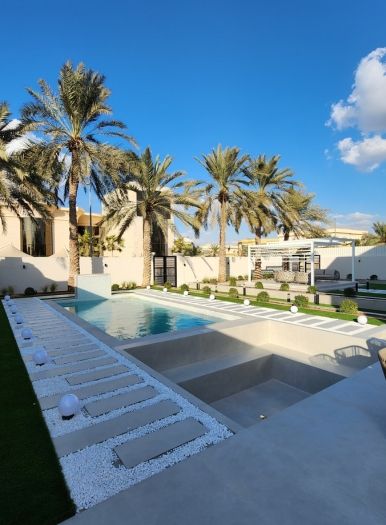
Project Majestic
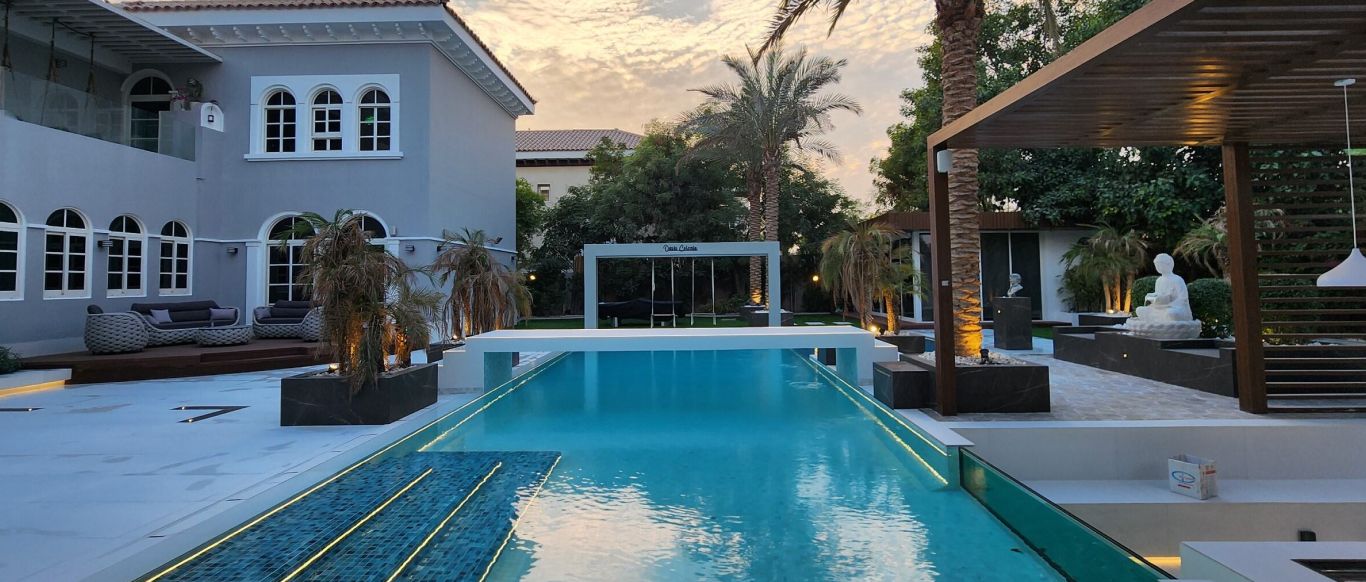
Al Twar, Dubai · Q4 of FY2024A pool with a raised wall at its far end, edged by stepping slabs in white pebbles, with a sunken structure beside it and the gazebo beyond, in Al Twar.
View project →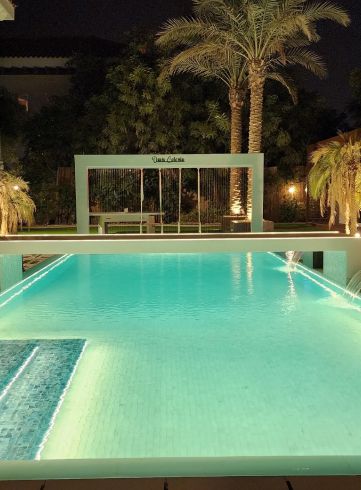
Project Casa Colonia
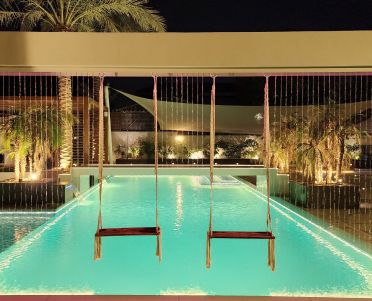
The Villa, Dubai · Approx. 600 sqm · Q3 FY26 to Q4 FY26A long pool lit turquoise at night in The Villa, with a mosaic-tiled section, water jets arcing in from the edge and a white bridge.
View project →More of our work: YouTube · Instagram · our Google reviews
How we handle pool cooling
Project Study
A free site visit to see the garden, where the sun falls across the water, the equipment space and the electrical supply.
Plan
Shade, finishes, water features, pool type, depth and equipment are agreed as one scope, with the chiller or heat pump sized alongside the pump and filter. We apply for any approvals ourselves.
Visualization
You see the pool, the deck, the pergola and the equipment area in 3D before work starts, so the unit's position is settled on the drawing rather than on site.
Execution
Our own team builds or renovates the pool, runs the pipework and electrics and commissions the equipment, with one project manager as your contact.
Questions and answers
Do I need a pool chiller in Dubai?
What is the difference between a pool chiller and a pool heat pump?
Can you add a pool chiller to an existing pool?
Where should a pool chiller be installed?
How is a pool chiller sized?
Is a pool chiller noisy?
Does a pool cover help keep the water cool?
More guides
Our related services
Contact Us
Ready to bring
your vision to life?
Get in Touch
We appreciate your interest in OutMazed ® Design and would be delighted to assist you with your design requirements. Our team of professionals are committed to providing you with the highest standard of service and satisfaction possible.
Please feel free to contact us and let us know what you're interested in or looking for. We are here to assist you whether you need help with a new project, renovation, or just some design advice. Fill out the contact form below, and one of our staff will contact you as soon as possible.
Alternatively, you can also reach us via phone or email, and our friendly staff will be happy to help you. We encourage you to take the first step towards transforming your space with OutMazed ® Design by contacting us today.