Saltwater vs chlorine pools in Dubai villas
A saltwater pool and a chlorine pool are closer than the names suggest, because both keep the water clean with chlorine and differ only in where it comes from. This guide explains how each system works, how the water feels, what each asks of a Dubai villa owner through a long summer, what salt does to stone and fittings, and what converting an existing pool involves.
Free site visit · Approvals handled by us · Designed in 3D
A saltwater pool is still a chlorine pool
The first thing to know is that a saltwater pool is not a chlorine-free pool. Salt is dissolved in the water, and a salt chlorinator in the plant room passes that water over charged plates that turn part of the salt into chlorine. The chlorine cleans the water and then reverts to salt, so the cycle repeats. In a conventional chlorine pool the same sanitiser is added from outside, as liquid, granules or tablets. So the choice for a Dubai villa is between making chlorine on site and bringing it in, and that changes the feel of the water, the routine, the equipment and what the water does to the materials around it. Neither suits every pool, and this page does not pick a winner. If you are planning a new pool, our swimming pool construction team settles the water treatment at design stage, together with the shell, the finish and the plant room.
How each system works in a Dubai pool
Both systems sit on the same circulation of pump, filter and returns. The difference is the last step before the water goes back to the pool.
The salt chlorinator
A cell is plumbed into the return line after the filter, with a control unit on the plant room wall. Chlorine is made only while the pump runs, so in the Dubai summer the pump hours and the output setting are raised together to keep up with the sun. It makes the sanitiser only; the water still has to be tested, balanced and filtered.
Manual chlorine dosing
The pool technician tests the water on each visit and adds chlorine to bring it back to the right level. It is the familiar routine in Dubai villa communities, and it works when the visits are frequent enough for the season.
Automatic chlorine dosing
A probe reads the water and a small pump feeds liquid chlorine and acid from containers in the plant room. The level stays steadier between visits than with hand dosing.
How the water feels in each pool
Softer water, and less of the pool smell
Owners who change to salt usually describe the water as softer or silkier. The salt level is a small fraction of the sea's, low enough that most swimmers do not taste it, and the water does not leave the crust on skin and swimwear that a day at Jumeirah beach does.
The sharp smell many people call chlorine is mostly a sign of water that is out of balance, and it can turn up in either type of pool. In the Dubai summer the bigger influence on comfort is often the water temperature, which our guide to pool chillers and cooling covers. In a plunge pool for cooling off, where you sit with the water at your shoulders, the feel of the water is noticed more than in a long pool you swim through.
What each system asks of the owner
Most Dubai villa pools are looked after by a visiting technician, so the practical question is what each system needs from that routine, and what happens between visits in August.
- Salt: the cell needs cleaningScale forms on the plates of the cell, faster where the refill water is hard and the pool is warm. The cell is inspected and cleaned as part of the routine, and it is a wearing part that is replaced in time.
- Salt: acidity drifts upwardsMaking chlorine in a cell tends to push the water towards the alkaline side, so acid is added regularly. Left alone through a Dubai summer, the drift encourages scale on the tile line and inside the cell.
- Salt: the salt level is checkedSalt does not evaporate. It is lost through backwashing, splash-out and leaks, and diluted when the pool is refilled, so it is tested through the year and adjusted when it drifts.
- Chlorine: supply and storageSomeone has to buy, carry and store the chlorine, and a plant room in a Dubai garden gets very hot, which weakens liquid chlorine. Containers want shade, ventilation and separation from acid.
- Both: someone who knows the systemA salt pool handed to a technician who treats it like a tablet pool is soon out of balance. Our pool maintenance service tests and balances the water, cleans the filter and checks the pump room whichever system the pool runs on.
Finishes, fittings and stone around the water
Salt is gentle in the pool and harder on what dries beside it
Inside the pool, the finish matters more than the sanitiser. Tile and well-made grout cope with either system as long as the water is kept in balance, and our guide to pool tiles covers the choices. A tiled or plastered concrete pool shell is the more sensitive to water that drifts out of balance, while the gel coat of a one-piece fibreglass pool generally tolerates salt chlorination well; the two shells are compared in our post on concrete and fibreglass pools.
The trouble with salt starts where the water dries. In the Dubai heat, splashes on the coping and the deck evaporate quickly and leave salt behind, and over the seasons the crystals can pit and flake soft, porous stone such as some limestones and sandstones. Dense porcelain and hard stone stand up to it far better, and sealing and a rinse with fresh water help every surface. Metal is the other weak point: ladders, handrails, light rims and balustrade clamps need a grade made for salt water, and chillers and heaters must be rated for it as well. That is why the pool and its surround are worth choosing together, which is how our pool and landscape design-build team works.

What a Dubai summer does to the water balance
Heat, sun and evaporation move the chemistry of every pool here, and they affect the two systems in slightly different ways.
Evaporation concentrates everything
Water leaves a Dubai pool every day in summer, but the salt and minerals stay. Each refill adds more minerals, so hardness climbs over the season in both types of pool, and in a salt pool the salt reading can creep up too.
Sun and warm water use up chlorine
Sunlight breaks chlorine down and warm water lets algae take hold quickly. A chlorinator has to be sized for a Dubai August, not for a mild climate, or it runs flat out and still falls behind.
Scale shows first at the water line
Hard, warm, alkaline water deposits scale on the tile line, on water features and on the plates of a salt cell. A skimmer pool with a fixed water line shows it as a pale band on the tiles when the balance has been left to drift.
Backwash water has somewhere to go
Filter backwash from a salt pool is salty and should run to the drain, not onto the lawn or the planting beds. The developer or community management may have rules on where pool water is discharged, so check before the plant room is planned.
Converting an existing pool to salt, or back
Changing system rarely means rebuilding anything, but an older Dubai villa pool is worth a careful look before salt goes into the water.
- What is addedA chlorinator cell in the return pipework, a control unit on the wall, a power supply and the salt itself, dissolved into the existing water. The pool does not normally have to be drained. Going back is simpler still: the cell is switched off and the pool is dosed in the usual way.
- What is checked firstThe heater or chiller, the ladders and rails, the light fittings, the grout and the type of stone on the coping. Anything not suited to salt is replaced or protected before the change, not after the first marks appear.
- Where the unit goesThe control unit is electronic and does not like a sealed, sun-baked enclosure. In older villas the plant room is often cramped or badly ventilated, and improving it may be part of the job.
- A good moment to do itThe change is simplest when the pool is already being worked on, because coping, fittings and pipework are open anyway. Our swimming pool renovation work starts with a study of the shell, the equipment and its location, and the water treatment can be decided in the same review.
Villa pools from our projects
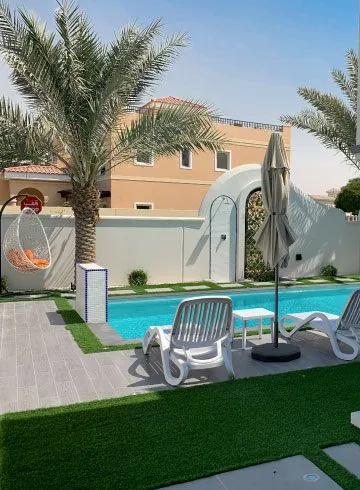
Project Jewel
The Villa, Dubai · 750 sqm · February 2020 - July 2020White sun loungers, a closed parasol and a hanging egg chair under a palm beside the pool, with an outdoor shower on the arched garden wall. The skimmer swimming pool was part of a villa makeover in The Villa that also included a new kitchen, remodelled bathrooms, covered parking and landscaping.
View project →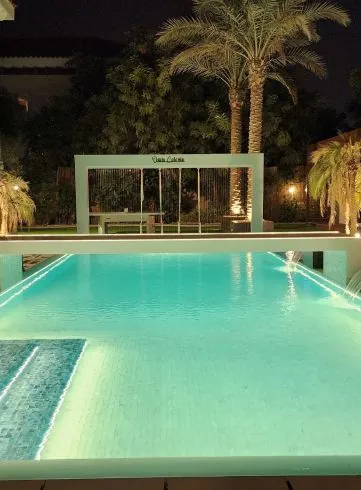
Project Casa Colonia
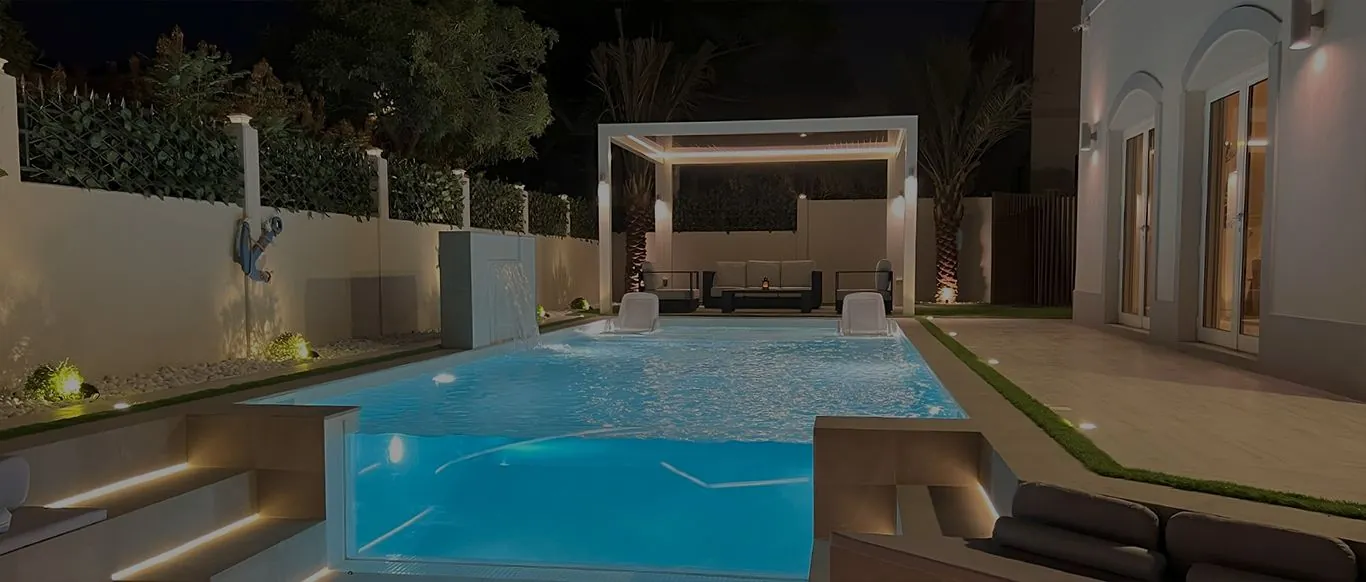
The Villa, Dubai · Approx. 600 sqm · Q3 FY26 to Q4 FY26A pool lit turquoise at night, with water jets arcing in from the edge and uplit palms behind. The outdoor transformation in The Villa created a poolside environment with underwater and perimeter LED lighting, rain showers, swings and water features.
View project →More of our work: YouTube · Instagram · our Google reviews
Questions and answers
Is a saltwater pool chlorine-free?
Which is easier to look after in Dubai?
Will salt water damage my pool deck?
Can my existing pool be converted to salt?
Does evaporation change the salt level?
Does a salt system work with a pool chiller?
More guides
Our related services
Contact Us
Ready to bring
your vision to life?
Get in Touch
We appreciate your interest in OutMazed ® Design and would be delighted to assist you with your design requirements. Our team of professionals are committed to providing you with the highest standard of service and satisfaction possible.
Please feel free to contact us and let us know what you're interested in or looking for. We are here to assist you whether you need help with a new project, renovation, or just some design advice. Fill out the contact form below, and one of our staff will contact you as soon as possible.
Alternatively, you can also reach us via phone or email, and our friendly staff will be happy to help you. We encourage you to take the first step towards transforming your space with OutMazed ® Design by contacting us today.